In my previous article on the psychology of belief, I examined the relationship between intelligence and political views. Specifically, I showed that intelligence is associated with economically right-wing and socially left-wing views. I speculated on several reasons why this relationship is not necessarily due to the intrinsic rationality of such beliefs, regardless of the degree to which I adhere to them.
In this article, I will examine what research says about the relationship between political belief and rationality.
But first, what is rationality? After all, virtually anyone who has a set of beliefs they are passionate about will say that their beliefs are more rational than the beliefs of others. But how can we find an objective way to assess the relative rationality of, for instance, liberals versus conservatives, if the definition of what “rational beliefs” is invariably contested?
Measuring Rationality
The way to address this challenge is to assess rationality using measures beyond the “rationality” of a particular set of political beliefs. In other words, rationality is assessed through non-political measures, with the goal of determining whether individuals can properly evaluate what is true in domains that are, in whole or in part, external to political argumentation.
One example of this is through testing people’s ability to assess syllogisms correctly. A syllogism is a form of deductive reasoning whereby one is presented with two premises and a conclusion. The task is not to figure out whether the conclusion is true, but whether the conclusion deductively or definitively follows from the premises. In other words, if the premises are true, does that mean that the conclusion is true?
Here are two simple examples of syllogisms. You can try them out yourself and see if you can determine whether the two are valid. Remember, the challenge here is to figure out whether the conclusion logically follows from the premises:
Syllogism 1:
Premise One: All men are mortal.
Premise Two: Socrates is a man.
Conclusion: Therefore, Socrates is mortal.
Syllogism 2:
Premise One: All men are mortal.
Premise Two: Socrates is mortal.
Conclusion: Therefore, Socrates is a man.
The answers are below:
…
…
…
The correct answers are that syllogism 1 is valid, but syllogism 2 is not valid. Syllogism 1 is simple. As premise 1 shows, all men are mortal. Thus, anything which falls under the category of “men” would be said to be mortal. Since, according to premise 2, Socrates is a man, he falls into the category of “men” and thus is mortal, assuming the two premises are correct. Hence, the syllogism is valid.
On the other hand, syllogism 2 is not valid. In syllogism 2, we are once again told that all men are mortal. This means that anything which falls under the category of “men” is mortal. However, this does not mean that anything which falls under the category of “mortal” is a man. Thus, it cannot be inferred from the fact that Socrates is a man that Socrates is mortal. Hence, the syllogism is invalid.
These are two simple syllogisms that are apolitical. They don’t deal with conclusions or premises that may be disputed by people with differing political viewpoints. Now, let’s try two more syllogisms, but in this case, they are more overtly political in their nature. Once again, remember that the goal here is not to try to figure out whether the conclusion is true, but whether the conclusion naturally follows from the premises.
Syllogism 3:
Premise One: All drugs that are dangerous should be illegal.
Premise Two: Marijuana is a drug that is dangerous.
Conclusion: Therefore, Marijuana should be illegal.
Syllogism 4:
Premise One: Judge Wilson believes that if a living thing is not a person, then one has the right to end its life.
Premise Two: She also believes that a fetus is a person.
Conclusion: Therefore, Judge Wilson concludes that no one has the right to end the life of a fetus.
The answers are below:
…
…
…
The correct answers are that syllogism 3 is valid and syllogism 4 is invalid, for similar reasons to those that made syllogism 1 valid and syllogism 2 invalid. I will skip the explanation for syllogism 3, as it was a near-identical deductive problem to that of syllogism 1.
In syllogism 4, we are presented with the idea that Judge Wilson believes that if a living thing is not a person, one has the right to end its life. Note that this says nothing about what Judge Wilson believes ought to be the case if a living thing is a person. Therefore, one cannot infer from the fact that she believes a fetus is a person that she believes that no one has the right to end the life of a fetus. Hence, syllogism 4 is invalid.
Research on Syllogisms
These last two syllogisms come from the paper Gampa et al. (2019), which conducted three studies to examine whether ideology impairs reasoning, and the extent to which it does among people of differing ideological persuasions.
Across the three studies, it was determined that when a syllogism had a conclusion that favored conservatives, liberals were better at identifying flaws when it was invalid, and worse at determining that it was correct when it was valid. On the other hand, when a syllogism had a conclusion that favored liberals, conservatives were better at identifying flaws when it was invalid, and worse at determining that it was correct when it was valid. Both liberals and conservatives were roughly equally able to assess arguments in general, controlling for the argument’s ideological bias. Thus, according to their research, liberals and conservatives were about as rational as one another when assessing syllogisms.
A second study, Aspernäs et al. (2022), looked at the same question. They found that people of a more right-wing self-reported political orientation were worse at correctly solving leftist syllogism problems (i.e., problems where the correct answer is a leftist conclusion). In comparison, people of a more left-wing self-reported political orientation were worse at correctly solving rightist syllogism problems (i.e., problems where the correct answer is a rightist conclusion):
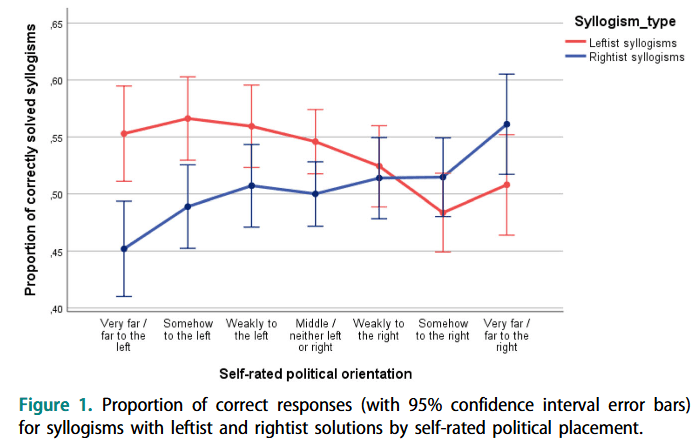
In other words, people were much better at solving syllogism problems when the correct answer to the syllogism was consistent with their own political beliefs. At the same time, they were significantly worse at solving them when it was consistent with an ideology they opposed.
The overall difference between leftists correctly solving rightist syllogism problems and rightists correctly solving leftist syllogism problems was about the same, meaning that people of both political persuasions were about as bad at solving problems that involved them having to say that the correct answer was a viewpoint they opposed. Similarly, the overall difference between leftists correctly solving leftist syllogism problems and rightists correctly solving rightist syllogism problems was about the same, meaning that people of both political persuasions were about as good at solving problems that required them to say the correct answer was a viewpoint they supported.
In short, both of these studies suggest that leftists and rightists are about as good at solving syllogism problems. Still, both will engage in motivated reasoning to scrutinize more harshly perspectives that differ from their own.
Research on Informational Evaluations
An additional piece of evidence surrounding the level of rationality across political ideology concerns informational evaluations. If rightists and leftists differ in their levels of rationality, we would expect that one group would be better at objectively evaluating information rather than in a partisan manner.
Many studies aim to answer this question and find no difference. In reality, both rightists and leftists tend to engage in the motivated disbelief of certain pieces of information.
Ditto et al. (2019) conducted a meta-analysis of 51 experimental studies examining this question. They found that liberals and conservatives had the same tendency to evaluate otherwise identical information more favorably when it supported their political beliefs or allegiances than when it challenged them. In other words, rightists and leftists do not differ in the extent to which they engage in motivated skepticism of information that challenges their perspectives.
Explaining the Results
What is going on here? It appears that people’s beliefs become less rational when politics is involved. When a person’s beliefs have to do with something that doesn’t directly deal with society, such as a belief about a mathematical fact, people are more likely to correct their beliefs in the face of new evidence. However, in politics, people appear more willing to dig in their heels, even when it is not rational to do so.
There is some evidence that suggests that many of the neurobiological correlates of politics are the same as those of religion. Kaplan et al. (2016) looked at what parts of the brain are involved with maintaining one’s political beliefs in the face of counter-evidence on the subject. They found that those with greater belief resistance tended to show greater dorsomedial prefrontal cortex activity and decreased activity in the orbitofrontal cortex. In addition, they found that those who changed their minds on the subject showed less activity in the insula and amygdala when evaluating counter-evidence.
How does this line up with religious belief? Rim et al. (2020) conducted a review of the literature on neurobiological correlates of religious belief. They found numerous correlates, including the orbitofrontal cortex, insula, and amygdala. In short, politics from a neurobiological perspective may be very similar to religion. Under this notion, rather than being rational assessments of the world, political beliefs serve functions similar to those of religious beliefs: promoting social cohesion and a sense of purpose among people.
People are naturally social creatures and will thus gravitate towards belief structures that give them a sense of purpose, regardless of whether those structures are true or false. The falsity of a belief may impose a relatively small cost compared to the social cohesion it provides. As such, people are generally more likely to adopt an irrational belief about politics if it helps them adapt within a group context.
In fact, in some cases, a false belief that imposes high costs on the believer may actually be a feature of belief systems, as the investment made in the belief demonstrates some level of trust in one’s community. Think of blood pacts, a ritual in which people make a cut on their own hands and shake each other’s hands as a physical cost associated with an agreement, which is more likely to be fulfilled as a result. A similar thing might occur with some beliefs that impose a high cost on the believer but are undertaken for the benefit of social cohesion.
As a result, virtually all beliefs that involve some sort of community will become irrational in their justifications by their nature. In the hard sciences, beliefs are much more likely to be rational because there are no social benefits to having one set of beliefs over another, aside from the direct costs or benefits derived. When there are real social costs associated with being wrong and few social benefits, beliefs are more likely to be rationally derived. Ideology is not one of those cases.
Conclusion
There are two major implications to take from this body of research. The first is that people of any political persuasion, left or right, cannot claim a monopoly on rationality. While the previous article on IQ and political beliefs found that intelligence is correlated with economically right, socially left views, this has nothing to do with the actual rationality of those views. Despite an IQ advantage often found among liberals, there is no actual difference in rationality between the two groups.
Second is the importance of intellectual humility. People’s beliefs are subject to a wide variety of cognitive distortions, which lead them to be ignorant of certain realities and blind to their own ignorance. This was adaptive to social cohesion, but societal progress necessitates a conscious effort to abandon these impulses. It’s only when we genuinely try to abandon them that we can move forward as a civilization.

Leave a Reply