Are people of one particular ideology more “moral” than those of a differing political ideology? Certainly, everyone believes that their own political beliefs are the most moral. If you’re a leftist, you think leftism is moral, and if you’re a rightist, you think rightism is moral. So, if you’re a leftist, you will naturally, in a sense, believe that leftists are more moral, and vice versa.
However, there are other aspects to a person’s character than what policies or ideology they happen to have. I actually think that one of the great tragedies of the modern era is how much stock we put in people’s beliefs, to the point where we view people as evil for disagreeing with our ideas.
A person is not defined by their political beliefs, and there is more to being moral than whether they happen to hold the “correct opinion”. Merely holding a “good” opinion or a “bad” opinion, materially speaking, has very little consequence on the world compared to other behaviors, such as whether one is willing to donate to charity or whether one is law-abiding.
This is the question I am more interested in. What moral patterns of thought or moral behaviors that are more fundamental than political beliefs differ between people on the left versus the right? This question will involve indirectly discussing political beliefs to a degree, but it will be done when needed to contextualize or explain certain differences that persist. As I will show, however, even though this question was intended to be asked in an apolitical manner, the answer depends on one’s political preferences.
One important caveat to bring up before I get into the data: this data is entirely correlational and does not necessarily deal with why people might have the traits they do or behave in the ways they do. I don’t believe that anything here can be reasonably used to argue that having a particular set of political beliefs will cause someone to engage in moral or immoral behavior. It is entirely possible that it could in one way or another, but caution should be exercised in interpretation.
Empathy and Caring Orientations
One psychological area where there is a clear difference between leftists and rightists is the area of empathy. It’s very common to see leftists accuse rightists of lacking empathy for some group of people. And there is some truth to this difference in empathy between the two political camps.
Unlike the variable of intelligence, which is correlated to some right-wing ideas and some left-wing ideas, empathy is clearly correlated with left-leaning political beliefs along both social and economic dimensions.
My view is that this is a psychological trait which is reflective of a fundamental difference in values and priorities between leftists and rightists. As I have said before, leftism can be best understood according to the idea of the “expanding moral circle”. In short, leftists tend to value giving more entities moral consideration, as well as equating entities on outer (less genetically or relationally proximate) moral circles with entities on inner (more genetically or relationally proximate) moral circles.
This leads to leftists having a greater moral emphasis on addressing “inequities” or “injustices” between groups in inner versus outer moral circles, such as on the basis of race or class. It also helps to explain why certain movements, such as veganism, which advocate for non-human animals to be granted greater moral consideration, are typically considered left-wing movements.
It should be noted, however, that virtually everyone has a view on the moral circle and believes that it should include some entities and exclude others. The core difference between leftists and rightists is where they draw that line and how much they might value other priorities. In the case of leftists, their beliefs derive from an intuition which sees equality between people as a fundamental descriptive reality, as well as a prescriptive ideal in varying senses. This can be seen in their views on both social and economic issues.
While rightist beliefs do not start from a moral endorsement of inequality or hierarchy per se, they tend to place less emphasis on equality in favor of other sets of ideals. This can be reflected in lower empathy.
I have discussed my views on the “expanding moral circle” previously, although I have not laid out a full-fledged outline of them and why I have the views I do on it. Suffice it to say, empathy is certainly a fundamental aspect of morality which should not be dismissed, and can be valuable in moderation in certain political areas and also in certain professions or tasks, such as the nursing profession or the raising of children. However, in excess, it can lead to harm when other values are neglected. It should not be the driving force of one’s political belief.
As a result, I do not regard this difference in empathy between rightists and leftists as an intrinsically good thing, and actually believe that the over-emphasis on moral foundations that derive from empathy has, ironically enough, led to a lot of harmful beliefs being propagated.
Moral Behavior
What about political differences in moral behavior? For example, are there political differences in people’s level of selfishness in their actions, or in their propensity for criminal behavior?
There are a number of ways that one could potentially measure this, but one of the best quantified and clearest ways is the charitability of people. And research shows that conservatives are significantly more charitable than liberals in terms of voluntary donations.
This does vary depending on which study one looks at and what domain of charitability one looks at, with Pizziol et al. (2023) finding that liberals are more charitable than conservatives, particularly in terms of international generosity. Consistent with the idea that liberals are concerned with the expanding moral circle, the charitability which liberals tend to exhibit is more towards outgroups such as people living in different countries compared to conservatives.
However, the bulk of research suggests that on the aggregate, conservatives are significantly more charitable than liberals in terms of voluntary donations. Yang & Liu (2021) conducted a meta-analysis of 421 effect sizes from 31 studies and found that while there was heterogeneity depending on the scenario, conservatives in general were much more likely to give to charity than liberals were.
One caveat to this research is that, while on an individual level, conservatives appear to be more charitable than liberals, conservative areas as a whole are less redistributive than liberal states. Paarlberg et al. (2018) found that the total levels of redistribution when looking at both private and government sources are higher in Democratic-leaning countries, not Republican-leaning ones.
This is because while Conservatives tend to engage in more charitable donations, they are less likely to support government redistribution policies, and the greater private charitability does not compensate for the lower social expenditure. The stronger ability for governmental forces in modern societies to provide redistributive services than what can be organically provided by the private market is one reason why I advocate for some level of a social safety net. While there is a crowding-out effect of social spending, where higher government spending on redistribution is associated with lower private spending on redistribution, the effect is not 1:1. As such, government redistributive programs have a net anti-poverty effect.
One could make an argument that conservatives are more charitable in their behavior, because they voluntarily give more to charitable causes. However, one could also reasonably make an argument that liberals are more charitable, because they on net give more through their support for redistributive policies, even if they do not voluntarily give as much to charity. What might on the surface appear like a clear instance of conservatives being more personally moral, is in reality a more complex story.
Another area of personal behavior, which is interesting and may be more clear-cut, is criminality. On average, liberals tend to report engaging in more criminal conduct, and this relationship is linear across the political spectrum.
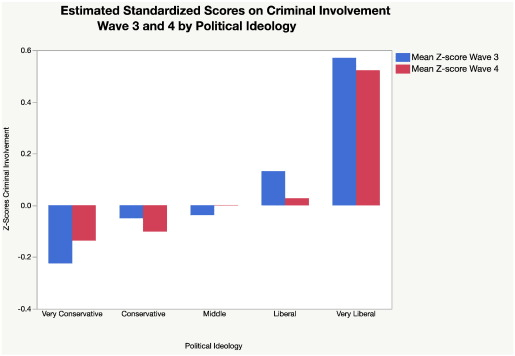
In other words, in the research, those who had the highest propensity for criminality were those who were far-left, while those with the lowest propensity for criminality were those who were far-right.
This effect may be due to liberals having a general more anti-authority and rebellious nature to them, which could translate into a greater propensity for anti-social behavior. It may also be that people who commit crimes wish for people to be less stigmatizing and “softer” on crime, and so are more likely to vote and believe in liberal ideas.
While this is one area where there could be a clear difference in morality between liberals and conservatives, the preponderance of research can be read in very different ways, and lead one to very different conclusions. In reality, even though conservatives and liberals do differ in their propensity for “moral” behaviors, it’s difficult to argue that conservatives are clearly more moral than liberals, or liberals are clearly more moral than conservatives.
A Related Paradox
One issue which I run into with doing this type of research is a paradox between how liberals and conservatives tend to view the morality of thoughts and actions. Liberals tend to advocate for more restorative or rehabilitative approaches to criminal justice, and tend to argue against “tough on crime” stances. Meanwhile, conservatives tend to support more investment into policing and prisons, and appear to have much more negative emotional attitudes towards criminality in general.
This strongly implies that conservatives care more about the harm which criminal actions can do, while liberals care more about the well-being of criminals. This is not to suggest that conservatives do not care about the well-being of criminals at all, or that liberals do not care about the harm which criminal actions can do, but there does appear to be a difference in relative emphasis between those of differing beliefs.
However, research also suggests that liberals tend to be much more punitive in terms of speech relative to conservatives. For example, liberals are substantially more likely than conservatives to believe that the government should ban public hate speech.
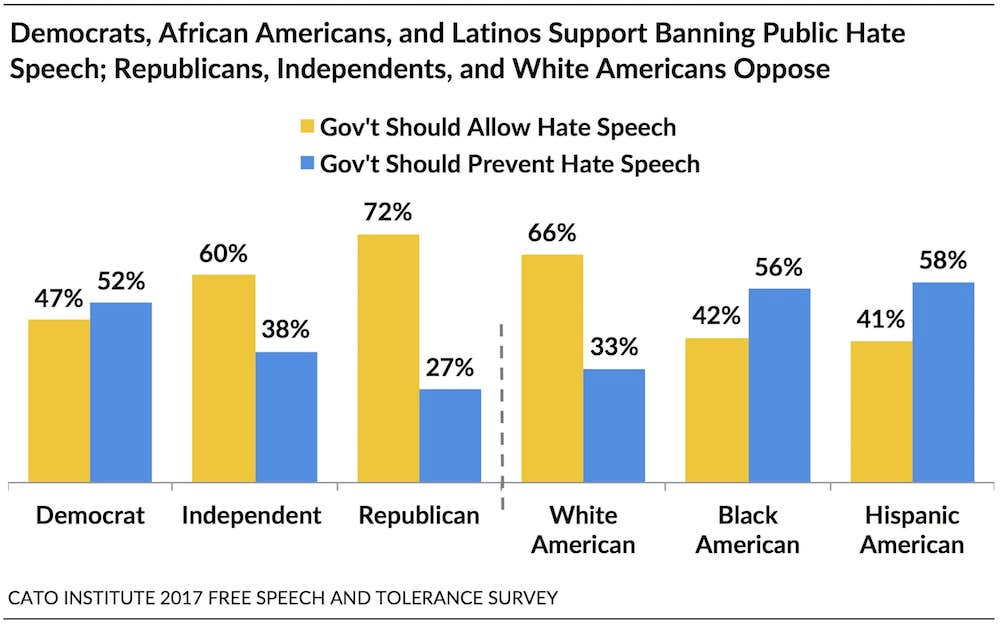
In short, liberals tend to care more about thought as expressed in their attitudes about speech, and support restrictions on that basis, while conservatives tend to care more about actions as expressed in their attitudes about crime. This ironically implies that liberals have an idealist conception of the world, which conflicts with the environmental or materialist attempts to explain the world that leftists generally express a support for.
I think that this has to do with the ways their moral foundations line up. Leftists tend to be explicitly anti-hierarchy to a greater degree than rightists, and so will be more rebellious in their actions. However, they will favor speech restrictions for groups which they view as having low status in society.
While rightists are oftentimes viewed as being more conformist, this is only the case under particular conceptions of what conformity is. In reality, both rightists and leftists tend to be conformist, just towards different groups.
Rightists tend to display more obedience towards authority figures or traditions, including commanding officers and religious authorities. On the other hand, leftists tend to display more obedience towards leaders who advocate for their particular causes, including civil rights activists and environmentalists.
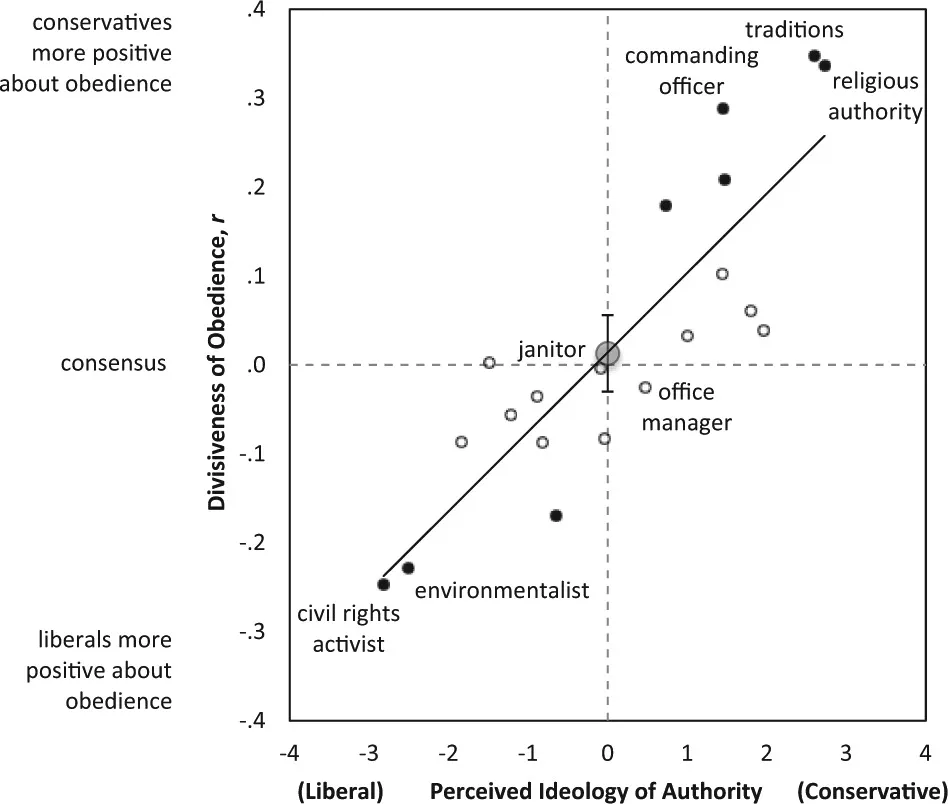
Leftist rebellious behavior, as proxied by a higher likelihood of engaging in criminal behavior, can be viewed as an attack against groups that they are not obedient to, while their views on speech could be viewed as an attempt to protect groups they are obedient to. This may help explain what appears on a surface level to be a contradiction in their thought pattern of caring about ideas more than real-world actions. What’s actually going on is that leftists tend to prioritize what will empower those they perceive as on the outer edges of the moral circle, most notably minorities, and will evaluate actions according to whether they empower or disempower that group.
I should say that I do regard this thought pattern as harmful. I am merely trying to explain it in terms that help it make sense – in a culturally relativistic way of sorts. Nonetheless, what this does suggest is that the link between ideology and morality is difficult to answer. Just like whether one believes the political beliefs themselves are good, it depends on one’s political preferences.

Leave a Reply