Summary
This article examines the topic of population differences in intelligence across geographic groups, a subject that is extremely controversial. I argue that the subject should be studied and openly discussed in academic and policy circles, with some caveats, and that the preponderance of empirical evidence is consistent with such differences being of mixed genetic-environment origin. I go through several lines of evidence demonstrating that such a position is not unreasonable, and show that accepting population differences in intelligence is not intrinsically related to prejudice against other groups, extreme political positions, and that acceptance may actually reduce group conflict in society. Much of political activism today is dedicated to fostering resentment about group-based inequality, erroneously assuming that disparities imply discrimination. A reasoned position that acknowledges group differences in intelligence while opposing discrimination would ultimately lead to significantly more harmony and benefit people of all groups.
Introduction
There are few topics in the social sciences or in politics that inspire as much controversy as that of population (or race) differences in intelligence. The topic inevitably combines two topics which are already hot-button on their own – namely race, which is by itself taboo, and intelligence research, which, despite producing some of the strongest and most well-replicated psychometric research in the social sciences through the use of the intelligence quotient (IQ), is still aggressively attacked within much of the mainstream.
Many professors and academics have been blackballed by their institutions or mobbed for discussing the topics, or even in some cases, for merely advocating that it should be openly discussed and debated.
Perhaps the most high-profile instance of an academic getting mobbed for their views on this is the late James Watson, a Nobel prize-winning molecular biologist who was one of the scientists responsible for the discovery of the double helix structure of DNA. He served as the director of the Cold Spring Harbor Laboratory and maintained ties with the institution following his directorship. However, following his remarks about population differences in intelligence, most notably expressing the position that the reason why people of African ancestry on average score lower on intelligence tests compared to people of European ancestry is due to genetics, the laboratory eventually cut ties with him.
There are also a large number of professors and academics who have been mobbed or had positions revoked in recent years, including Noah Carl and Nathan Cofnas at Cambridge University, and Bo Winegard at Marietta College, among many others.
The topic is thus extremely taboo, and I do believe that there is some good reason for it being so. However, despite the taboo nature of the issue, there is a lot of largely hushed support for the idea of population differences in IQ existing and potentially being genetic amongst mainstream commentators and academics on the right and center-left, including Ben Shapiro, Jordan Peterson, Charles Murray, Richard Hanania, and Jonathan Haidt, to name a few.
My position is that population differences in IQ are real and are due to a mix of genetic and environmental factors, as virtually all traits are. Extensive research on the subject suggests that, on average, people of Jewish and East Asian ancestry score higher than people of European ancestry on IQ testing, and that people of European ancestry, on average, score higher than people of African ancestry. These gaps in cognitive ability testing mean that different groups, on average, have differing levels of general intelligence. However, it does not preclude anyone from one group from being of any level of intelligence, nor does it suggest that all members of one group are smarter than all members of another group. Individuals are not the sum of their demographic averages, and they should never be seen as such.
While the question of group differences in intelligence is a very uncomfortable issue, and in part rightfully so, I believe that some degree of open acknowledgement of the reality would help improve race relations as they exist today and ultimately benefit anyone. As has been pointed out by the aforementioned philosopher Nathan Cofnas, the core assumption of the dominant view on race in academia, which justifies calls for DEI policies, is that all races or population groups are equal in their genetic propensity for intelligence. If all groups are genetically identical in psychological traits, then any inequality in outcomes between groups can be attributed to racism or some other injustice, which must be rectified.
The problem comes when this fact is not the case. If all groups are not genetically identical in psychological traits, and this explains present inequalities, there is no reason to expect equal outcomes between groups, and the push for equal outcomes in the form of DEI policies and other reforms is not merely ill-informed but actively creates harm. It creates division through blaming racial inequality on historical oppression by white people against other groups, which must then be rectified by white people today. This leads to significant conflict and declining social cohesion, which is based on incorrect assumptions about the world. It also risks leading to a general mismatch in institutions, where race may become emphasized when considering who should be filled in institutions, potentially at the expense of competence. This leads to systemic inefficiency, which creates indirect harm for everyone.
I believe that open acknowledgement of population differences in intelligence, if combined with a proper ethical framework, would help rectify this significant divisiveness, repair race relations, and potentially benefit people of all races. That said, it is not something that I think should be discussed in polite conversation. Many facts about the world are important to acknowledge from a policy perspective, but are best treated carefully in polite discussion.
One example is the facts surrounding the health effects of obesity, which should be stated lightly if at all in casual conversation. However, this does not mean that we should deny that obesity has negative health effects, censor any research into the subject, or engage in policymaking that assumes that obesity doesn’t have negative health effects. We need to do the same with acknowledgement of group differences in intelligence. Group differences in intelligence should be largely kept quiet in interpersonal conversations. Still, they should inform policy insofar as they show that attempts to equalize outcomes between groups are largely not possible, and insofar as they show that disparities in outcomes do not necessarily indicate that discrimination has occurred.
The core issue is that this topic has, in my view, been stigmatized to the point where it is virtually anathema even to imply that it may be the case, and this is in part due to a moral panic surrounding race, which, while in some cases well-intentioned, ultimately risks leading to an exacerbation of racial animus and division.
As I will show, acknowledging group differences in intelligence in no way suggests that we should be bigoted or hateful towards other groups, or that segregation, anti-immigration policies, or classical eugenics are justified. Furthermore, rather than stoking racial conflict, if used carefully, research on group differences can actually undermine the intellectual foundations that have been used to justify racial conflict or genocide at many points throughout history.
Before I get into those arguments, however, I will begin by laying out several facts which make a purely environmental account of group differences in IQ untenable. The purpose of this is not to lay out why group differences in IQ are partly genetic, but to lay out why the position that they are is not unreasonable, and contrary to the assertions of some, is a mainstream position among relevant experts and perfectly scientifically defensible. Following this, I will move on to ethical concerns surrounding the investigation and discussion of group differences in intelligence, and lay out why its destigmatization would not cause harm and may in fact decrease it.
A Few Facts on the Table
I will not go through the entirety of the evidence surrounding group differences in intelligence having a partly genetic origin. Instead, I will review three pieces of evidence which, taken together, imply that the environment-only account of group differences should not be dogmatically regarded as the only possible reasonable position on this topic.
Evidence #1: Expert Opinion. A common misconception that has been extensively repeated online is the idea that genetic group differences in intelligence are not a majority position amongst scientists who study the topic. This misconception has even extended to Wikipedia. To quote their article entitled “Race and Intelligence”:
“Today, the scientific consensus is that genetics does not explain differences in IQ test performance between groups, and that observed differences are environmental in origin.”
This claim has been repeated extensively in news outlets as well as other Wikipedia articles whenever the topic of group differences in intelligence is brought up. But what does actual polling on the subject suggest? Is it indeed a scientific consensus that genetics plays no role in explaining group differences in intelligence?
To answer this question, we have to look to scientific polling. A 2020 survey of 102 experts on intelligence research broadly asked the experts, among other questions, what they estimated to be the degree to which the observed difference in average intelligence between American blacks and whites was due to genetics versus environment. The sample leaned politically center, if not center-left, and so had no strong ideological reasons to argue in favor of a genetic explanation. In addition, the survey was done using a similar methodology commonly used among climate researchers to establish the claim that there is a consensus among climate scientists that humans cause global warming. Thus, there is no reason to expect a strong ideological bias among the researchers or that the survey methodology is especially biased in some way.
So what did they say about the genetic versus environmental influence on the observed IQ difference between blacks and whites? Here is the distribution of results:
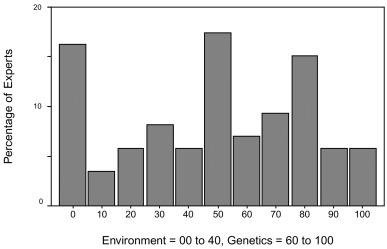
According to the survey, only 16% of intelligence experts favor a 100% environmental explanation for the observed IQ gap between blacks and whites. The median expert attributed the gap to 50% genetics and 50% to the environment. In other words, the vast majority of experts, as well as the median expert, hold to a mixed genetics-environmental explanation for population differences in IQ, at least in the most well-studied case. Contrary to the idea that the view that genes play a role in population differences in intelligence is a fringe view, survey data shows that, if anything, the view that genes play zero role is a fringe view.
I am not someone who believes that just because the majority of experts believe something to be true, it automatically becomes true. My view is that expert consensus can be a sign that something is true, but that any deeper attempt to investigate an issue should focus primarily on empirical evidence rather than appeals to expert opinion. The fact that the majority of experts’ views align with a mixed genetics and environmental explanation for population differences in intelligence does not suggest that said explanation is true. Still, it does imply that the explanation is not unreasonable to hold.
Evidence #2: Population Genetic Differentiation. Homo sapiens as a species has only existed for around 200,000 years, and it was only around 50,000-70,000 years ago when humans are estimated to have begun travelling outside of Africa. Many assert that genetic divergence between populations in psychological traits cannot occur over tens of thousands of years and actually takes hundreds of thousands of years or more.
However, this goes against contemporary evidence, which suggests that human evolution can actually occur extremely rapidly at certain times. Research suggests that over the past 40,000 years, human evolution has been speeding up, and over the past 5,000 years, that pace has grown 100 times faster. This is likely due to the reality of gene-culture interactions resulting in rapid human evolution along a variety of traits.
We can look at where this population genetic differentiation occurs between humans, and the evidence shows that there is strong genetic differentiation along traits related to the brain. For example, Wu & Zhang (2011) found that between human populations, genes relating to brain characteristics, including dorsoventral neural tube patterning, hindbrain development, positive regulation of neuron differentiation, and neuron development, all differed more between groups than genes relating to skin color, including pigmentation and melanocyte differentiation:
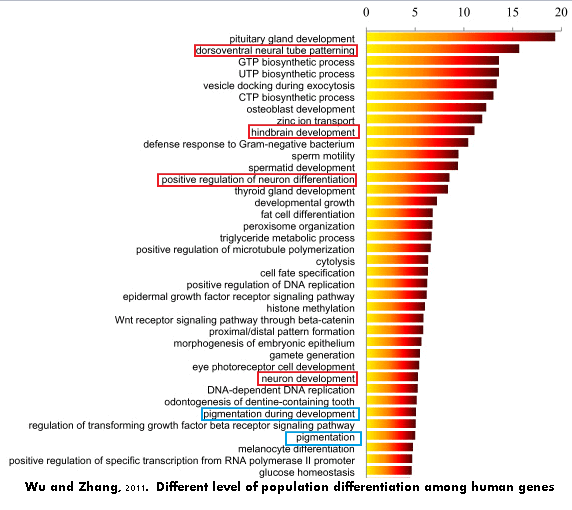
In other words, from a molecular genetics perspective, there is stronger evidence in favor of genetic population differences existing in many psychological traits, including traits related to intelligence such as neuron development, compared to genetic population differences existing in skin pigmentation – the most clear and visible genetic demarcation between population groups.
Like the evidence on expert opinion, this does not automatically suggest that there would be genetic differences in intelligence between population groups. However, this is the opposite of what would be expected to be true if genetic differences in intelligence did not exist, and exactly what would be expected to be true if genetic differences in intelligence did exist.
Evidence #3: Quantitative Genetic Evidence. There have been many pieces of research done that attempt to find genes related to academic attainment and intelligence. These are done using what is referred to as a “genome-wide association study” (GWAS) – the identical methodology as is used to find genetic risk factors for obesity and other traits.
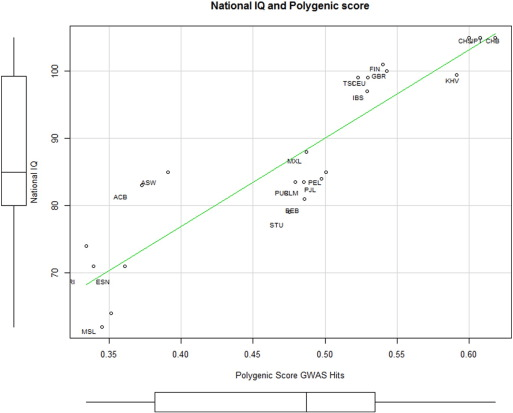
This type of research has been done not only to investigate individual differences in intelligence, but has also been used to investigate group differences in intelligence. For example, Piffer (2015) looked at several alleles that had previously been shown in GWAS studies with a majority of European samples to be significantly associated with intelligence. These alleles were packaged into a population-level polygenic score, or a numerical value that estimates the genetic propensity for a certain trait, which was then regressed on national IQ data. The results found that countries differed significantly in their polygenic scores in a way that strongly predicted their national IQ scores:
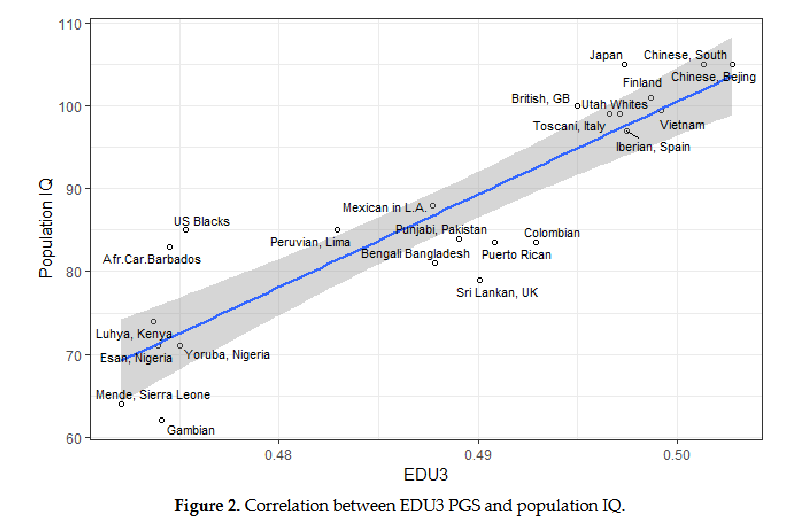
Similar results were found in a 2019 study, which looked at polygenic scores for educational attainment and intelligence, once again based on GWAS hits:
Similar results were also found in research investigating average differences in intelligence between Jews, Catholics, and Lutherans, findings that polygenic score differences heavily mediated the Jewish advantage found in intelligence testing.
One critique of this line of research concerns whether GWAS hits are portable across population groups. While this is always a risk, research into the portability of polygenic scores for intelligence has found that it likely isn’t a risk. For example, Piffer & Kirkegaard (2024) found that a European-derived polygenic score for intelligence performed better than a lower-sample-size East Asian-derived polygenic score for intelligence in comparing intelligence differences across Chinese provinces. While this is likely due to the fact that the East Asian-derived polygenic score had lower statistical power, this is the opposite of what one would expect if polygenic scores for intelligence had limited portability across population groups.
The quantitative genetics research, while once again not definitive evidence in favor of population differences in intelligence, shows evidence that is the exact opposite of what would be expected if population differences in intelligence were of entirely environmental origin. If they were entirely reducible to the environment, we would either expect to see that genes are not related to intelligence in general, or, if they are, that they do not differ significantly between population groups. Research using GWAS hits and polygenic scores finds that neither of these facts holds.
In short, the three lines of evidence outlined here strongly point to the possibility of population differences in intelligence being of partly genetic origin, meaning that we cannot reasonably rule this out as a possibility. The view that population differences are in part genetic in origin is a perfectly reasonable position to hold, is mainstream within the community of relevant experts, and is consistent with a large body of research on the subject, of which this article has barely scratched the surface.
Addressing Concerns
Here, I will go through a number of concerns that individuals have, which affect whether they think that this type of research should be done or discussed.
Does accepting population differences in IQ mean one is a racist?
No. The evidence of population differences in IQ does not justify claims of superiority of some groups over others, or the notion that we ought to have hatred towards those of different groups. To see why these responses would be irrational, we should consider the fact that some individuals are more intelligent than others. This is a fact which everyone implicitly recognizes in their day-to-day life. And yet, people do not have a sense that just because some individuals are smarter than others, it means some individuals are superior to others, or that we ought to have hatred towards less intelligent individuals. Either response to individual differences in intelligence would be viewed as strange at best.
In fact, it would be more rational to view individuals as superior to others or have hatred towards individuals than to do the same with groups, since any attitude one has towards a group ignores the high internal variability which exists within that group, whereas an individual is an individual. An individual doesn’t have any variability to speak of. The fact that hateful or superiority-based attitudes towards individuals on the basis of intelligence are viewed as irrational and yet are more rational than having such attitudes towards groups suggests that those attitudes would be extremely irrational to have towards groups. In reality, any reasoned acceptance of population differences in intelligence does not whatsoever imply that one has prejudiced attitudes towards those of different racial groups.
A common misconception that exists about accepting population differences in IQ is not only that they are inevitably used to justify notions of superiority, but specifically that they are used to justify notions of white superiority. This is especially erroneous, for the reason that white people as a race are not the highest-scoring group on intelligence tests. Research consistently shows that East Asians score substantially higher on intelligence tests, as do other non-European groups. Many of those who research or discuss population differences in intelligence are themselves non-white, including Satoshi Kanazawa, Meng Hu, Lipton Matthews, Razib Khan, and Bruce Lahn. In fact, as Anatoly Karlin has pointed out, communities that discuss population differences in intelligence are, in many cases, incredibly racially diverse and have individuals motivated in studying or discussing the topic for a range of reasons. This is the opposite of what would be expected if this line of research were being done for the purposes of justifying the superiority of a specific racial group.
This does not mean that I stand behind everything that every individual who believes in genetic population differences in IQ has said. In a previous article, I discussed my view on how race should be addressed on a political level, and there are many people who believe in population differences in intelligence who would agree with my prescriptions, and many others who would disagree. However, accepting population differences in intelligence in no way implies that one has racial hatred or views of racial superiority.
I don’t believe that this information should affect how people are treated interpersonally, and it has had little effect on how I have treated people interpersonally throughout my evolution of views on this subject. Temperamentally, I’ve always been a fairly cosmopolitan person irrespective of what my views have been on this issue, as are many who accept population differences in intelligence. In a sense, the idea of population differences existing in a wide variety of physical and psychological traits is beautiful, because it shows the immensely diverse tapestry of people, which makes the world so much more interesting.
Does accepting population differences in IQ mean that one has to be right-wing, anti-immigration, or pro-eugenics?
Not at all. Many people who accept population differences in intelligence do not identify as right-wing and can be apolitical or consider themselves liberals. Furthermore, among those who accept population differences in intelligence, there are widely differing views on immigration, with some preferring an open immigration policy, such as myself or Richard Hanania, while others prefer immigration restrictions. While intelligence differences can factor into how some people evaluate immigration policy, there is no reason to expect that they will automatically.
One common misconception that has continued to plague discussions about race and genetics is the idea that accepting population differences must mean that one supports eugenics. The term “eugenics” can have a lot of meanings, but it generally revolves around the use of policy to affect the genetics of a society, often through coercive means. Under this definition, virtually everyone can be argued to be a eugenicist to some degree. As the evolutionary psychologist Diana Fleischman points out, virtually everyone supports laws that prohibit siblings or other close family members from having sexual relationships due to the genetic consequences of inbreeding, policies that would easily fall under eugenics.
However, even though such policies fall under the technical definition of eugenics, the term intrinsically carries negative connotations, which means the term should generally be avoided. The real underlying question that should be asked is whether accepting population differences in intelligence means that one has to support greater coercive efforts to affect the genetics of the human population. And the answer to that question is no. Just as accepting individual differences in intelligence would not justify coercively sterilizing people or preventing people from having children, neither would accepting group differences in intelligence. While some people who accept group differences in intelligence support such coercive efforts, there are some people who reject group differences in intelligence who also support such coercive efforts, and there are people such as myself who accept group differences in intelligence yet do not support them.
Would accepting population differences in intelligence lead to greater conflict?
No, and it may actually lead to lower conflict in the long run between groups.
There is a good reason for people to be concerned about racial conflict in general. While some argue that race is, in effect, a form of extended family, and that, therefore, in the same way that familial conflict is not a civilizational-level concern, neither should racial conflict, this ignores the reality of how conflict emerges. Conflict can emerge along group lines when they are socially salient and clearly distinguishable. In industrialized societies where there are thousands or even millions of families in a single area, family no longer becomes a salient social category. However, because race has distinct visual cues and there are a distinct number of socially defined races in any society, race is a socially salient category which can thus motivate conflict, regardless of whether we want this to be the case or not. Multiracial societies can be some of the most prosperous societies in history, but in order to achieve this, it is crucial to reduce between-group conflict.
There have been many atrocities throughout history that were committed against people, in part or in whole, on the basis of race. However, many of these atrocities were not motivated by the acceptance of race differences, but actually the reverse. Take the holocaust, for instance, which was perpetuated by the Nazi Party. The holocaust primarily targeted Jewish people, based on the idea that they were responsible for the economic problems which Germany was facing in the 1920s and 1930s, appealing to the fact that Jewish people were disproportionately successful in German society. However, in order to come to this conclusion, the Nazis had to ignore the fact that Jewish people were disproportionately successful in large part due to scoring nearly a standard deviation higher on intelligence testing compared to non-Jewish white people. Rather than acknowledging the reality that group differences in success were fundamentally meritocratic in origin when the Nazis themselves found that Jewish people scored significantly higher on intelligence testing, the Nazis rejected intelligence research because it disagreed with their ideological viewpoints.
This viewpoint does not justify an atrocity through accepting biological group differences, but through rejecting them. Research shows that genetic attributions of behavior are associated with higher levels of tolerance of vulnerable populations as defined by researchers, not lower levels. This is the opposite of what one would expect if accepting population differences in intelligence would cause conflict, and shows that conflict is not inevitably a consequence of it, and may actually help mute its very possibility.
Conclusion
As information about genetics continues to increase, more robust research into the causes of group differences in a wide variety of traits, including those beyond intelligence, will inevitably be produced, either directly or indirectly. Even if there are social or institutional restrictions placed on it, the process of researching other aspects of human genetics will almost inevitably lead to more discoveries on this topic. I argue that our respect for differences and belief in multiracial societies should not hinge upon what the empirical research says about human biodiversity.
As a society, we need to become more cognizant of differences and how to think about them, as technology will likely end up increasing genetic differences in the long term. As genetic technology advances, there will likely come a point when we will be able to genetically engineer humans to select for or against a wide variety of physical and even psychological traits. Due to potential differences in access to the technology, as well as differences in what people are interested in engineering, this will likely raise genetic differences between people to a level unprecedented in human history. If we don’t start considering the implications now, as well as how we should culturally handle acceptance of them, we will only be delaying the reckoning that will have to happen at some point.
My view is that group differences in intelligence should not be discussed purely openly. It is an uncomfortable topic as it deals with the topic of race, and the topic of intelligence, two touchy subjects in our present era. Discussions about this issue should be culturally seen as slightly taboo in the same way as discussing the link between obesity and health is taboo. Today, we have placed stigma against this topic at a nine or ten out of ten level, when it should probably be more like a three or four out of ten. Not anathema to talk about, and something which should absolutely be researched and inform our understanding of the world and policy, but not something which should generally be discussed in polite company.
It is crucial to be honest about group differences if we want to live in cohesive and prosperous societies, as resentment over inequality is difficult to explain without appealing to such differences. This is not a fact which I personally wish were true, as it is quite uncomfortable, and I am personally strongly disincentivized from holding it. However, we need to be able to understand what is true about the world if we want to build better societies for all.
“There is a most absurd and audacious method of reasoning avowed by some bigots and enthusiasts, and through fear assented to by some wiser and better men; it is this. They argue against a fair discussion of popular prejudices, because, say they, tho’ they would be found without any reasonable support, yet the discovery might be productive of the most dangerous consequences. Absurd and blasphemous notion! As if all happiness was not connected with the practice of virtue, which necessarily depends upon the knowledge of truth.”
– Edmund Burke

Leave a Reply