I have previously discussed the fact that the neurological correlates of political belief are, in many cases, the same as those of religious belief. This strongly suggests that political beliefs effectively function as religious beliefs in a sense. The fact is that most people’s political and religious beliefs are better understood as ways to signal conformity to social groups as opposed to honest attempts to ascertain what is true or false about the world. When I argue that people of leftist ideologies are no more rational than people of rightist ideologies, it is perhaps better to say that people of leftist ideologies and people of rightist ideologies are equally irrational in terms of their ability to consider logical argumentation.
Many facts are discussed in “The Elephant in the Brain: Hidden Motives in Everyday Life” by Kevin Simler and Robin Hanson. This book argues that many of the behaviors people engage in are better explained by self-interest masquerading as altruism, and that people will offset the cognitive load associated with deception through sincere belief that they themselves are altruistic. This has implications in virtually all domains of life, which include but are not limited to politics.
For example, despite the notion that people generally engage in political activities because they want to help others, people are uninformed to a shocking degree about actual policy. When people are asked about the identical policy question twice over the span of a few months, they very often give differing answers. This is not because they changed their minds, but because they are making up answers on the spot without remembering what they previously said.
One study, Hall et al. (2012), gave citizens a survey of their moral opinions, which covered both foundational moral principles as well as controversial issues in the media. The survey used a magic trick to expose participants to a reversal of their previously stated moral attitudes and tasked them with arguing in favor of the reversal of their moral attitudes. The majority of these reversals were not detected by participants, and 69% of participants did not detect even one of the two changes. In arguing in favor of the reversal, participants generally constructed coherent and unequivocal arguments, which implies that people’s moral attitudes are extremely flexible and are easily flipped through trickery.
So if many beliefs in domains like politics are not generally held for rational reasons, and if politics is neurologically speaking analogous to religion, then what does that say about the “religiosity” of particular political beliefs? In this article, I aim to outline a way by which religiosity of beliefs can be theorized and measured, and examine whether this property may differ across ideologies, specifically the left-right divide. I will show that leftist belief, psychologically speaking, appears to function more like religious beliefs compared to rightist beliefs.
Assessing the Relative Religiosity of Beliefs
But what makes certain beliefs more religious than others? In the context I am discussing this, I do not refer to religiosity in terms of belief in the existence of a god. If this is the case, then certainly right-wing beliefs would be more religious, given that right-leaning people tend to be more religious. I am referring more to religion as a sociological or behavioral phenomenon. Certainly, in common discourse, a person who believes in the existence of a god can be described as more religious than a person who does not believe in a god, all else equal. However, a Catholic who regularly goes to church, prays before meals, and practices traditional sexual ethics, all else equal, can be said to be more religious than a Catholic who does none of those things. The point is that there are broad behaviors and attitudes that can make a person more religious irrespective of their underlying beliefs.
In a generalized sense, I assert that more religious people can be said to have two characteristics. Firstly, they tend to hold a certain set of beliefs particularly strongly, and those beliefs adhere strongly to a particular doctrine. By holding a belief strongly, this means that it is held more strongly as a part of one’s identity, a person more regularly engages in behavior to venerate or uphold that doctrine, one gets more sensitive when their beliefs are challenged, and they are more concerned with whether other people and society more generally subscribe to their beliefs. This can be referred to as cardinality, a concept taken from utility theory in microeconomics, which, in this case, refers to how much importance one places on something or how strongly one believes in something.
The second characteristic, related to the first, surrounds how tightly packed the beliefs are across individuals, such that individuals within the group become more difficult to distinguish from one another in terms of the context of their belief. This can be referred to as homogeneity. Religious doctrines which can be regarded as extremely “religious” are those which tend to hold to certain ethical principles much more strongly, such as sexual ethics, and tend to explicitly endorse one particular view on the world, such as young earth creationism. Such doctrines, because they have a tighter hold on older theistic views of the world, tend to have much more homogeneity in their beliefs, whereas doctrines which have been more loose tend to have a range of opinions surrounding evolution or sexual ethics.
So the two dimensions upon which beliefs can be viewed as more religious or less religious are cardinality and homogeneity. To take a simple example in the context of political belief, let’s look at people who would regard themselves as “apolitical” or those who do not care about politics. These people would display low cardinality in politics, given that they, by definition, do not pay attention to or care about politics. Similarly, because apolitical people do not pay attention to particular debates going on or what social groups may say are good or bad ideas, will likely have more variation in their political opinions compared to people who are extremely passionate about politics. Thus, they would also likely display low homogeneity as a group. Thus, we can say that apolitical people are low in the religiosity of their beliefs, such that they could effectively be regarded as “atheistic” in their political beliefs.
Ideological Differences in Belief Cardinality
Now that this has been clarified, the big question to answer is whether leftist belief is characterized by greater cardinality and homogeneity, and thus greater religiosity. Beginning with cardinality, there are many lines of evidence which suggest that leftist individuals are significantly more passionate about their beliefs and care about whether others hold to them. Leftists tend to donate a significantly higher amount of money to candidates they support, and are also more likely to engage in non-voting political activities such as protesting and engaging in politics online compared to rightists/conservatives.
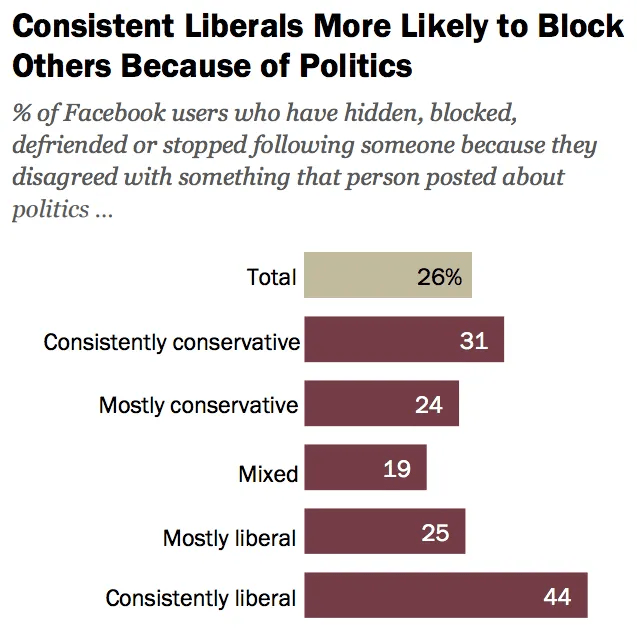
With regards to their attitudes towards political opponents, leftists are significantly more likely to block others due to their political views, as well as end friendships over politics.
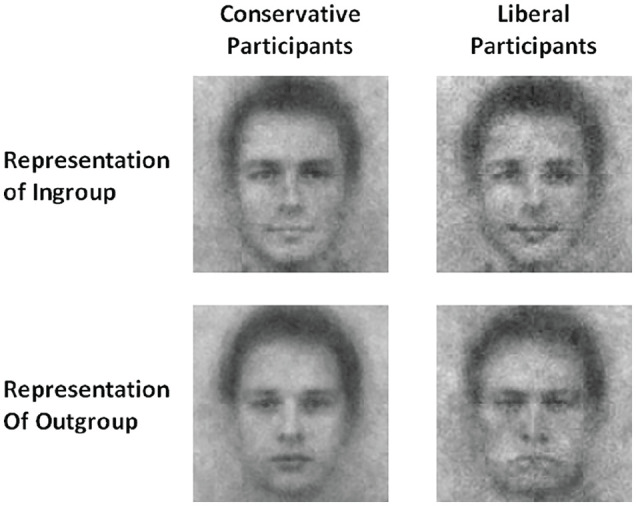
Research looking at psychological representations suggests that conservatives tend to view liberals as more immature in their mental representations of them. In contrast, liberals in their mental representations of conservatives tend to view them as more savage. In other words, it appears that rightists tend to view leftists as lacking information or maturity, while leftists tend to view rightists in more dehumanizing terms:
Despite the fact that leftists are more concerned with avoiding offending others when they speak in a generalized sense, they are more likely to feel comfortable sharing their political beliefs, while conservatives are most likely to self-censor. Furthermore, Democrats are more likely to favor banning hate speech, as well as banning the saying of offensive or insulting things about a group – even when it’s about things that Republicans would traditionally care more about, such as the military and the police.
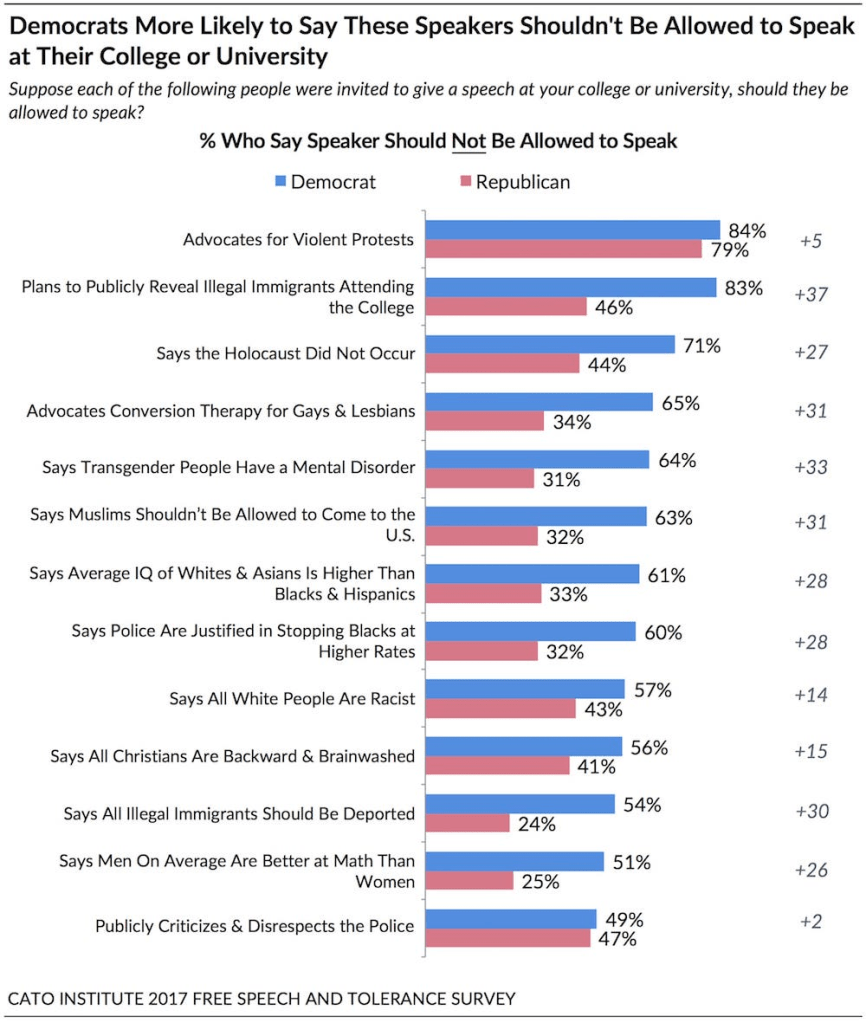
All of this points to a general pattern of leftists tending to display higher cardinality in their beliefs. They care more deeply about whether society and their social circles adhere to their ideas, which is why they are more likely to end relationships over political differences. They are more active in donating to political causes as well as engaging in various forms of conspicuous support, which signal that they care significantly more about their political causes. They tend to dehumanize their political opponents more, which shows that they hold their beliefs much more strongly, as they believe that anyone who holds differing viewpoints is intrinsically immoral. Finally, they are less likely to self-censor but more in favor of suppressing speech generally, particularly speech that goes against their ideas, which implies that they want to bend society to be in favor of their viewpoints through legal means.
Ideological Differences in Belief Homogeneity
But what about homogeneity? Do leftist attitudes tend to be more homogeneous in their nature compared to rightist attitudes? While rightists may be more conformist in general behavior, in terms of their beliefs, they are significantly less so. This can be seen in visual form in a recent study, which examined attitude networks between Democrats and Republicans. They found that the beliefs of Democrats tended to cluster significantly more than the beliefs of Republicans, suggesting that there is significantly more intellectual diversity on the right and that rightists tend to display less homogeneity in their beliefs as a whole:
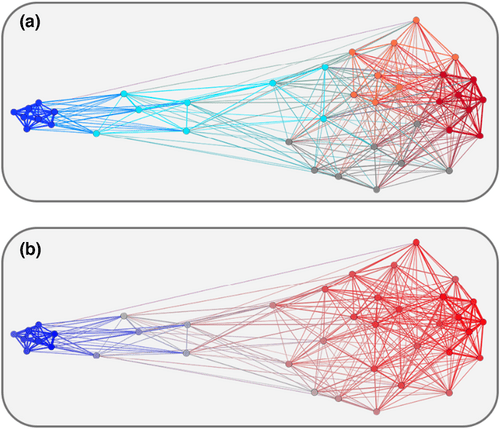
This research indicates significantly greater homogeneity amongst leftist beliefs. It is common to point out that there is a lot of infighting in leftist communities. While that is not unique to the left, leftist infighting tends to be over smaller issues substantively and is thus more aggressive in nature when controlling for the belief differences themselves. Furthermore, it is very common for leftists to engage in “canceling” of those on their own side, which can drive people rightwards even if their attitudes, functionally speaking, may not adhere to the average rightist on most issues. The high cardinality of leftist belief, as shown previously, can help explain why leftist infighting happens so much despite their beliefs being significantly more homogeneous as a group relative to rightist beliefs.
Is Religiosity of Beliefs a Good Thing?
I have said before that I am not religious from a theistic perspective. I do not believe in the existence of a God. That being said, I think the question of whether religious beliefs, generally speaking, are a bit more complex.
With regard to post-secondary institutions, I have advocated in favor of them being diverse in viewpoint, which means that I favor universities being low in the homogeneity of their beliefs. Culturally speaking, this requires individuals within such institutions to be low in the cardinality of their beliefs, such that everyone respects the right and ability for others to hold different viewpoints. Thus, I do lean in favor of sociologically non-religious beliefs inhabiting the culture and people within universities.
However, my views on organized religion and its sociological elements are somewhat mixed. Despite being an atheist, I do think there are harms associated with the decline of religion. I also think that a lack of spirituality, when not replaced by something else, while not being the most proximate cause, has been a contributing factor to the decline in community and mental health problems, as well as a contributing factor to the growing nihilism seen in more recent generations. Religiosity has been consistently shown to be related to better mental health, and communities that are religious in nature can foster greater social trust when made carefully and adaptively.
I’m not a leftist, but the problem with leftist beliefs is not necessarily that they are religious. High religiosity in beliefs can be related to a lower ability to discover new things in the world and adjust one’s priors, which is why some of the greatest suppressions of scientific research have existed on issues that risk challenging leftist dogmas. This is certainly a big issue, but if it also led to greater trust and cohesion, then it would not necessarily be the worst thing in the world.
The big problem with the religious nature of leftist beliefs is that even as sociologically religious communities, they are fundamentally maladaptive in nature to individuals. While other religious communities may inhibit scientific development, harming the collective to a degree while benefiting the individual through providing a functional and well-adjusted community, leftist communities appear to harm both the individual and the collective.
This can be seen through the relationship between politics and mental health. Unlike the positive relationship seen with theistic belief and mental health, practically every study done on politics and mental health has shown that leftists, on average, have worse mental health, as well as lower reported happiness and a lower sense of meaning in their lives. Unfortunately, it appears that the belief structure captures all of the worst elements of religiosity as a psychological construct, while leaving behind all its best elements.

Leave a Reply