Introduction
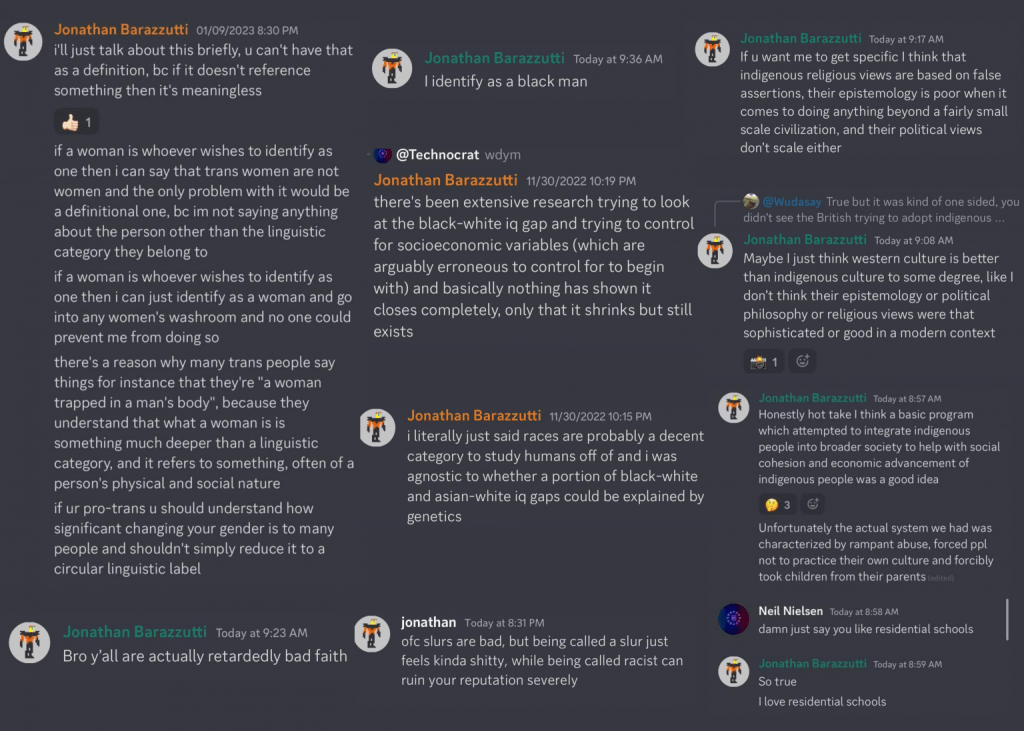
On March 7, 2024, an article was published by the University of Calgary’s student newspaper, entitled “Leaked screenshots reveal problematic comments made by Faculty of Arts representative candidate Jonathan Barazzutti”. The article contained a collage of “problematic” opinions I had expressed on Discord group chats one or more years prior to its release. It was primarily an overview of their contents as well as an abridged transcript of an interview I had done with the newspaper to try and defend myself.
The article was released just as the winter 2024 Student Union general election was coming to a close, an election in which I ran. I had not only lost the election, but over the next two years would be subject to a barrage of harassment, physical threats, attempts to get me expelled, blacklisting from student groups, social ostracism, and so much more.
While many would refer to this as a “cancellation”, I argue that it is better understood as mobbing, a form of group bullying whereby an individual is targeted and singled out for character assassination. The term has much greater specificity, is far better researched, and has fewer politicized connotations.
I have wanted to write an article on this subject for a very long time. However, I was extremely worried about doing so until now, and so continually put it off. I am writing this article now for several reasons. The first is a personal one. I am leaving Calgary soon, and so the immediate personal relationship consequences of getting mobbed will largely be unimportant. But as someone who is interested in having a public life as someone willing to do research, build institutions, and pursue the truth, I recognize that this incident will likely continue to be brought up long after I have left the institution that this happened within. There have been so many narratives spun about this situation publicly. Still, I have not fully articulated my side of this – which I believe is essential to understanding what exactly happened, and how to prevent it from happening to others in the future.
And that brings me to my second motivation. While there are many specific details which make this story a relatively unique one, mobbing is surprisingly prevalent within academia, on the same issues which I was mobbed for. Mobbing undermines the very cultural norms which make social progress possible, including freedom of speech, civil discourse, and diversity of thought – norms which I have written extensively about the importance of. It’s important to discuss both the broad trends as well as the personal tendencies of those who have been mobbed, as it helps bring a better understanding of what mobbing is, how it occurs, and why it can be so damaging, both to the target and to the broader social structure it occurs within. I thus don’t merely view this article as something which I should write for my self-interest, but as something which is my responsibility to discuss, as I have a unique experience which sheds light on a broader social issue. This should not be viewed as a personal story of an individual who was treated unfairly within a social system. It should be viewed as a warning for what happens when it becomes dangerous to question social norms in the very institutions which claim to support doing so.
I have made a number of mistakes in my life, many of which I will be discussing in this article. Yet the fact that I have made many mistakes is irrelevant to whether it is fair to suggest that I have been mobbed, and says little about whether the response to my alleged heresies was disproportionate. Throughout this story, I will try to give anonymity to those who played a key role in my mobbing by avoiding identifying details where possible. Over the past four years, I have had my privacy violated significantly, and in my belief that privacy is important, I have elected to respect the privacy of others, even when they have not elected to respect mine. This story is not about any one individual, but about systems which grant permission for mobbing behavior.
This article is my longest to date, at over 16,000 words in length. I have divided it into three main parts. Part 1 details my background, all of the inciting incidents which eventually led to me getting mobbed, and the aftermath. Part 2 looks at the sociology of mobbing and places the incident in a broader context. Finally, Part 3 goes through a number of political and social concerns, including whether mobbing helps those it claims to, and the possibility of forgiveness and institutional renewal. I ask that as the reader goes through this article, try to think about what the broader implications of these types of behaviors are. Do you want to see open academic institutions which promote debate and discussion between opposing sides, or do you think that this type of behavior is ultimately beneficial for the mission of academia? I leave it to the reader to decide.
Part 1: The Incident
Background: Before University
For as long as I can remember, I was very interested in ideas and logic problems in one way or another. However, it wasn’t until around the age of 13 that I started getting very much into philosophy and politics. I had a lot of strange ideas, but after discovering internet politics, I began identifying as right-wing. This phase lasted about two years, after which in high school I began adopting a much more left-leaning view, due to being exposed to a number of arguments from friends and online sources.
It was during that period of time that I became preoccupied with epistemology and the psychology of belief, as I was interested in the origins behind why people believe what they do. I thought that political disagreements existed primarily on the basis of differences in descriptive claims, and as such, figuring out what is true and getting to a common understanding of that is critical to mending political differences. One of the most foundational elements of this was my trust of expertise. Academic institutions came with individuals who displayed high competence and specialized knowledge. As such, I was very interested in reading research about the effects of particular policies as well as other general social science research. Was greater social spending associated with lower poverty? Did gender transition generally lead to an alleviation of psychological problems for gender dysphoric individuals? Were market-oriented economies more efficient than centrally planned ones? Was discrimination the primary cause of disparities between ethnic groups? All of these were empirical questions, each of which had a significant bearing on what policies and cultural attitudes one should support. In pursuing these and countless other questions, I began reading extensively and looking into what academia in general said about such questions, which led me to adopt socially left-wing values over time, given that said values were largely what the studies I was reading seemed to point to.
Whereas in middle school, I was ostracized due to a mix of personal character flaws, general social awkwardness due to being autistic, as well as my unpopular political views, following self-isolating for a year and a half, during which I read about all of these issues, I entered grade 12 feeling like I had a strong friend group. At the time, I had a left-wing YouTube channel where I would do a mix of scripted videos and debates, and I joined my high school’s newly formed Diversity Council – a club generally dedicated to social justice issues – as their communications director. In this role, I was actively involved in helping the club with various activities and contributing to weekly discussions on a range of topics.
However, throughout my stint in left-wing politics in high school, I experienced several intellectual tensions which persisted and only grew stronger as time went on. The big one was how I was supposed to relate to my previous right-wing views. I was pressured within the communities I was in to see my former views as intrinsically “fascist” or evil in some way. But there was no moral change in me personally between middle school and high school, which led me to hold leftist views eventually. Rather, it was largely changes in descriptive claims. For example, one of the strongest and most controversial views I had in middle school was on transgender issues, as I believed that transgender people were pretending to be the opposite sex and were deluding themselves in the process. It was not some change in my morality that led me to change my views on this. Rather, it was changes in my views on philosophy of language, as well as a shift in my descriptive understanding of the nature of gender dysphoria and the effects of gender transition, which ultimately led me to adopt the position I had in high school.
If it was the case that others within leftism could only conceptualize their opposition as people who are evil in some way, then it is difficult to imagine that they actually thought through their positions. It was also difficult to imagine that there was an ability to do honest research on the subject in the institutions which I had idealized so much. I felt pressured to retcon my past views in a way which was ultimately insincere, acting as if I was some formerly evil person who had “recovered” from something. Certainly, I had improved myself within that time span, but in terms of “moral” improvement that was largely a function of personal maturity in domains outside of my political thinking, as opposed to some grand improvement in my morality. I feared that my more “rationalist” way of arriving at leftism compared to my peers would inevitably lead to conflicts between myself and the people around me, as it was difficult to imagine that both approaches would lead to identical conclusions in all cases, much less the majority of them.
Related to this conflict was how I should relate to others who held differing views. Were these people merely immoral individuals who had to be stopped, or were they merely people who were ignorant from my view? Should I support deplatforming for people who held the same views I did in middle school, but fundamentally shared my abstract moral values which remained essentially unchanged between middle school and high school? I felt pressured to suggest that people who held right-wing views were intrinsically immoral, even though subconsciously I held that they simply didn’t know as much as I did. If I did think right-wingers were just evil, how could I try to honestly engage in issues?
Another big conflict came with a number of little contradictions I began seeing within the framework of leftism, which I felt pressured to ignore or hide. As I was beginning my role in my high school’s Diversity Council, one of the teacher organizers included in the club’s google drive a document from an anti-racism educator, which contained claims about how white people can be exhausting and other inflammatory things about white people. I was very dismayed seeing this, and confided in a close friend who was also part of the club a desire to leave and start a new club due to the content that was being shared at the start of the school year. While my friend did not agree with the content, he believed that we should stay because of the optics of leaving as well as the prospects of improving the club as time went on. But it became clear as time went on that there was no desire amongst him or other people in the group to critique negative elements which could come from progressive movements, even when it was in the group’s interest to do so.
Furthermore, it became increasingly obvious to me, even if I did not have the words to describe it at the time, that there were tensions between diversity and equity, as there were active pushes in leftist spaces for minority-only spaces, which I believed would ultimately undermine equal outcomes. I pointed out one of the ways this contradiction manifested itself to my main and predominantly leftist political friend group at the time, which was the opposition to white-only ethnostates but support for indigenous-only reservations, and got no satisfactory answers. I increasingly felt that the current way in which race relations were being discussed in progressive circles was internally inconsistent, something which was not meaningfully resolved with further conversations.
Another issue concerned human biodiversity, particularly whether different populations or ethnic groups could genetically differ in psychological traits such as intelligence (IQ). A common dogma within leftist circles was to effectively argue that this was impossible, and that the only cause of group differences in socioeconomic outcomes was discrimination – something philosopher Nathan Cofnas terms the “equality thesis”. I believed this, but I found that I wasn’t able to effectively defend it while arguing with people online, so I decided to do a deep dive into the research. After tens of hours of reading papers, I eventually realized that the debate about population differences in intelligence was extremely complex, more so than was so often presented in mainstream discourse, and that it was possible to reasonably have a hereditarian position on group IQ differences. And yet that position is treated as something anathema. I eventually stopped researching the topic, concluding that the truth was unclear and that if I was to be intellectually honest I would have to hold an uncertain position on it.
A fourth issue was on the “trans inclusion problem”, or how it was possible to maintain a coherent definition of what a “man” and a “woman” are while accepting transgender identities. I did a large number of online debates on transgender issues in high school, and became very proficient at arguing the progressive side on the issue. There was one time, however, that I encountered this issue in a debate, one which would become increasingly commonly discussed in public. I wasn’t pressed on it and avoided the question, but I eventually realized that the self-identification definition of men and women, whereby a woman is anyone who identifies as a woman and vice versa, is ultimately meaningless and circular, and as such was impossible to maintain coherently. While not changing my broader position on transgender issues, my evolving position on the use of language in gendered contexts did not jive well with the progressive orthodoxy on the issue.
While the K-12 school I was at from grade 5 onwards was always left-leaning, the school became particularly radicalized in its politics during the COVID lockdowns, which created significant pressure for me to conform and self-censor. This was compounded by the fact that I had gained a lot of social standing for my views, and so the increased questions I had about certain aspects of progressivism became increasingly risky to discuss. This pressure boiled over and led me to become quite agitated and abrasive by the time I was about to graduate from high school. I ended up having many more disagreements with my predominantly leftist friend group, and lashed out at them numerous times. I felt like I was the only person who was trying to come at leftism from an angle that valued consistency and rationality, and increasingly became frustrated that it did not seem like others were doing so. The conflicts ultimately led to me leaving the friend group, severing or inhibiting ties with people I was previously friends with for several years.
I felt intense guilt about how I had acted towards this friend group for a long time, and believed that a big factor behind me acting how I did was because I was unwilling to speak honestly about issues from the get-go. In response to this, I pledged to myself that I would never try to self-censor again, because I realized the psychological consequences of me doing so, and how alienated I felt as a consequence. I accepted that going into university, there would be risks that my acting upon this pledge would lead me to have many more severed ties than I already had, and that I may end up isolated as a result. However, what would actually happen as a result of this pledge was much more extreme than I ever would have expected.
Entering University: First Year
In the few months between high school and university, I felt intense freedom to question ideas I had previously had doubts about, and this led me to become more contrarian in my attitudes. I was still ultimately socially progressive on the vast majority of issues, but I was increasingly questioning things at the margins. But I also became resentful about the reality that some of my views were marginalized in academia, becoming increasingly aware of such realities. As someone who wanted to get involved in academic research and wanted an academic climate that was more tolerant of my willingness to question ideas, I became increasingly motivated to try and achieve as best as I could to gain legitimacy within academic institutions, so that I could ultimately change them for the better. I believed that anyone thoughtful, intelligent, and honest about their ideas would organically be able to change such institutions from within, a view which I now regard as naive and idealistic.
At my high school, which was a gifted education school where many of the students were exceptionally intelligent, the highest achievers ultimately went on to better schools, and some even went to top schools in the United States. I began to realize that much of admissions to top institutions came down to adopting a certain “grindset culture”. This involved two things. One was academics: get top grades, take the hardest classes, and do research if you can. The second was extracurriculars: get involved in student groups, start organizations, and make sure that everything you do has observable metrics. In late grade 12, I was already somewhat motivated to do this, and so began several initiatives which were consistent with this grindset culture while nonetheless being compatible with my interests. Most notable of these was a political podcast which would eventually develop into a club when I entered university. The name? Youth for Discourse (YFD).
But entering university, I decided to fully commit to this grindset culture. I was extremely motivated and began working harder than ever to get top grades. Alongside this, I began joining organizations and efforts, in addition to officially founding Youth for Discourse as a club with a close childhood friend of mine who was generally right-leaning. We created this club as a way to promote values such as civil and open dialogue, attempting to be a neutral, politically diverse forum for people to understand the viewpoints of others. The community we created through this club, as well as the people I was meeting in my classes, led me to feel very optimistic about the future, and I regarded my first semester as one of the best periods of time in my life. I also became very open about my views, which led me to get into many debates with more left-leaning individuals. These conversations occurred both in-person as well as online, and unfortunately, these conversations would increasingly boil over in a particularly aggressive manner.
For example, while with a few of the friends I had newly made in university, we were discussing the contents of the introductory sociology class one of them was taking. The sociology of race and ethnicity came up, which eventually led to the topic of race and intelligence coming up, something which was discussed in the class. I took the position that a genetic link was possible, a position which upset a few of the individuals I was speaking with.
One individual, who I will refer to as X, later brought up the topic on the discord server for YFD I had recently made. This led to a significant online argument. Some of the people from my old high school friend group were lurking within the YFD discord, and had invited others to join and begin arguing with me about the topic, inflaming tensions. During this argument, I was referred to as a Nazi and a racist, among other things.
I ended up lamenting about the situation in a private admin-only group chat where only a couple of executives of the club could see. I said something along the lines of how damaging it can be to a person’s reputation to be smeared as a “racist”, and how I would much rather be called slurs than be smeared in such a way. In this chain of messages about the situation, I asserted that the social consequences of being referred to as a “racist” were much worse than that of other derogatory terms, including slurs. One of the admins took this and linked it into a group chat that myself and X were both in to spark a discussion, which led to another large argument about the social consequences of certain words. However, after it all, it seemed like things cooled down between myself, X, and the various other people involved. I was not aware that things were getting worse behind the scenes.
I didn’t know that X was collecting and saving screenshots of everything I was saying that looked bad. In the process of being open about my beliefs, I was also very open about my ambitions, and how the reason why I was so industrious at the time was due to my desire to reform things ultimately. I also expressed a desire to continuously overachieve to succeed in my ambitions, most notably to eventually run for a position at my university’s Student Union (SU). Looking back, I believe that my open expression of this and my general academic successes were a partial motivator for why X had engaged in the behavior they did. On several occasions, X expressed a fear that I would succeed in my ambitions, and repeatedly argued that my strategy of being open with my beliefs would ultimately lead to failure.
When the first semester ended, I found out that X wanted nothing to do with me, despite having an outward polite appearance in virtually all of our in-person interactions. The next semester, I began making discord servers for all of my classes, one of which happened to include X. This led to significant conflicts within that class, which was a course about political ideologies. I would spark discussions on the server about the topics discussed in class by the professor or by students. During these conversations, I would try to play devil’s advocate occasionally, as well as be more hyperbolic with some of my answers in either an ironic way, or for the purposes of trying to start conversations. This was done in part because it was fun for me, but also because I believed that this was one way in which an engaging environment could be created where everyone, including myself, could learn.
In this process, X continually made snarky comments towards me, and as the weeks of the class went on, I eventually began making sarcastic remarks in response. The consequences of this came to a head when at one point, the topic of former Mount Royal University professor Francis Widdowson was brought up, a figure who was controversial for suggesting that the Canadian residential school system was not genocidal, and that there were educational benefits associated with the program. I was not familiar with Widdowson’s views or the details of the residential school program, and I was not in favor of the program. But I wanted to discuss the broad idea of indigenous integration, as it was one of the program’s primary stated intents. I had a strong moral opposition to ethnostates, and I believed that indigenous reservations effectively functioned as some. My view was that an integration of indigenous and non-indigenous people through legal and cultural means could help reduce inequalities between the two groups, and that certain educational programs may be beneficial in that process, in a similar way to what is done with immigrant integration services. I wanted to have a discussion on that, so I decided to use this as an opportunity to examine this.
As had happened repeatedly up until that point, X made a snarky comment accusing me of supporting residential schools, after which I sarcastically joked that I loved residential schools, an exchange which has perhaps become the most infamous controversy I have ever been involved in. This led into a full-fledged 8v1 argument in which I was repeatedly insulted and demeaned by various students who I did not know personally and were completely anonymous to me. Consistent with my general attitude of honesty, not self-censoring, and trying to be authentic, I usually went by my real name on discord servers, and this was no exception. But this led to an awkward scenario where virtually everyone in this class who was harassing me knew who I was, but I knew practically no one who was doing so – a strange and uncomfortable asymmetric situation.
This became a fairly miserable experience, and despite nominally facing far worse things at other points, I would actually consider this to be the lowest point emotionally in my entire undergraduate career. People were discussing the idea of going to administration about my views, and I later found out that X had in fact gone to administration, although nothing came of it. X had also begun ripping down posters I had put up to promote YFD across campus.
Ironically, the professor of the class had discussed the idea of “mobbing” at the beginning of the semester, something which very aptly described what would occur on the class Discord over the course of the semester. I had not heard of the concept in a sociological sense prior to this, but it would later prove invaluable to my understanding of everything that was happening at the time and thereafter.
Eventually, things seemed to calm down, particularly as several events, most notably a student protest which disrupted the class, appeared to unite many people on the Discord server. By the end of the semester, X had actually appeared to regret their previous actions towards me, and ended up privately apologizing to me in-person, seeming to grasp my actual views on things.
Despite what had happened, as my first year ended, things were looking up. It seemed that the drama with that class was coming to an end. I had gotten my first girlfriend, and it looked like opportunities for my student club and future were going in a positive direction. YFD was officially registered with the SU by the end of the year, which was a big step forward for the group. If only things would go as I thought they would.
Second Year: The Boiling Point
At the start of second year, I made it my mission to be much more aggressive in my involvement with extracurriculars and in expanding YFD. One position I started in was becoming a writer for my university’s student newspaper: The Gauntlet.
After everything which happened to me in the previous year, I became much more interested in freedom of speech issues on campus, including what university policy said about it as well as the SU. This was partly out of self-protection, given that my freedom of speech on campus had been legitimately threatened in first year, but was also due to personal interest. In this process, I had discovered a public statement the SU had made earlier that year, which argued in favor of deplatforming speakers such as the aforementioned professor Frances Widdowson, effectively arguing that the University of Calgary should reverse its existing policy which protected freedom of speech on campus.
I thus wanted to write an article for The Gauntlet critiquing the SU statement, defending the university’s status quo policy in the process. However, after a long deliberation and multiple drafts made, the editors ultimately decided to reject the article on the basis that I was not allowed to argue implicitly or explicitly that Widdowson should not be deplatformed. In other words, I was not allowed to defend my university’s own policy in the student newspaper.
I later found out that one of the editors of the newspaper who I was not in direct communication with, but who I happened to meet and befriend in first year, had grown a strong hostility towards me. While they never expressed this hostility in-person, and continued engaging with me in a friendly demeanor in the coming months, they would later be one of the individuals responsible for an article they would publish going after me.
While I was already intending on running for the SU, the incident with the school newspaper motivated me even more, and I was worried that if the university ever adhered to the demands of the SU, my academic career could be at serious personal risk. I thus decided to run for the Faculty of Arts Representative position in the 2023 fall by-election, making support for intellectual diversity and freedom of speech an explicit part of my platform – something I dubbed “diversity and expression” as a selling point. My primary goal in this domain was to get the SU to publicly write a statement affirming their commitment to freedom of speech on campus.
During the election season, I found out that I had some pushback from people over my previous arguments on discord, and people were attempting to go after me, most notably X. While I believed at the end of first year that things between X and myself were fine, it turned out not to be the case. In more aggressively promoting YFD on campus, I put up dozens of posters promoting the club prior to the start of the fall semester. However, I noticed that on the first day of the semester, many of my posters were gone. Further, I was informed by a mutual contact that X was bragging about ripping my posters down.
I was tired of continuously having X bother me, and was aware that ripping down my posters likely went against Section 2 of the university’s prohibited conduct policy, particularly given that my posters were promoting an SU-registered club. I knew I had a good case to go to administration about this behavior, which was a continuation of repeated harassment and related behavior in my first year. I decided to confront X in-person about it in a rather hostile way, and his extremely avoidant and sheepish response, combined with me telling them that I would go to administration if their behavior continued, made me believe that it would be the end of it. But it was not. I later found out that X was also rallying people in a Discord server for a large 200-level class to vote and prevent me from winning.
I ultimately lost the election, and despite the stress coming from related drama, it was fairly small-scale, and so I felt motivated to try again in the winter 2024 general election, where there would be more open spots. In the meantime, I ran multiple events with YFD, started back up a podcast for the club, and the community was growing at a solid pace. There was, however, one large hiccup I experienced with the club, and that was the management of our online Discord server.
Due to the online nature of the space, which promotes anonymity and depersonalization, people had an increased willingness to be rude and edgy to a highly excessive degree. In addition, there were many individuals from my old high school friend group lurking in the server – a number which would increase as time went on – who were against the values of the club. These two factors meant that the server devolved into many bad behaviors from people on multiple fronts.
I intentionally made the executive team politically diverse to uphold the value of intellectual diversity. This had the unfortunate tradeoff of leading to significant disagreements over how the server should be managed. I was also being continuously mocked and condescended to by a number of individuals, which combined with me having extensive duties in many areas, from academics to several clubs and projects on the side, led the situation to become very stressful for me. This was compounded by the fact that my general attempt to compromise with an executive team which had become very split on community management, largely on partisan lines, prevented effective management of the community.
At the time, I had not fully come to terms with the reality that open debate and intellectual diversity necessitates certain cultural norms to be established, which were both not believed or adhered to by many in the community, and which the medium of discord made it difficult to meaningfully adhere to. The deadlock I experienced on my executive team, combined with still trying to figure out exactly how a proper discourse space should operate myself, including what should or should not be allowed, led me to feeling extremely frustrated. Are there some perspectives which are too extreme to reasonably have a cohesive discourse space with? What is the role of edgy humor in a discourse space, and where can it go too far? And how patient should we be with people who do not fully adhere to the norms we were trying to establish with the group? These were difficult questions which I was continually wrestling with. I would often rant to a fellow executive who I became good friends with in private messages, using colorful language I would not publicly repeat to express my general frustration. Eventually, the server management challenges began to resolve, as some of the individuals who needed to be removed were removed, although there were still hiccups along the way.
As the online community of YFD was beginning to improve, the next SU election was underway, and I took a more ambitious and aggressive campaigning strategy to increase my odds of success. On the first day of the campaign period, I started going to classrooms and being active on social media. But I was notified that there was a copypasta going around class Discord servers about me, started by X:
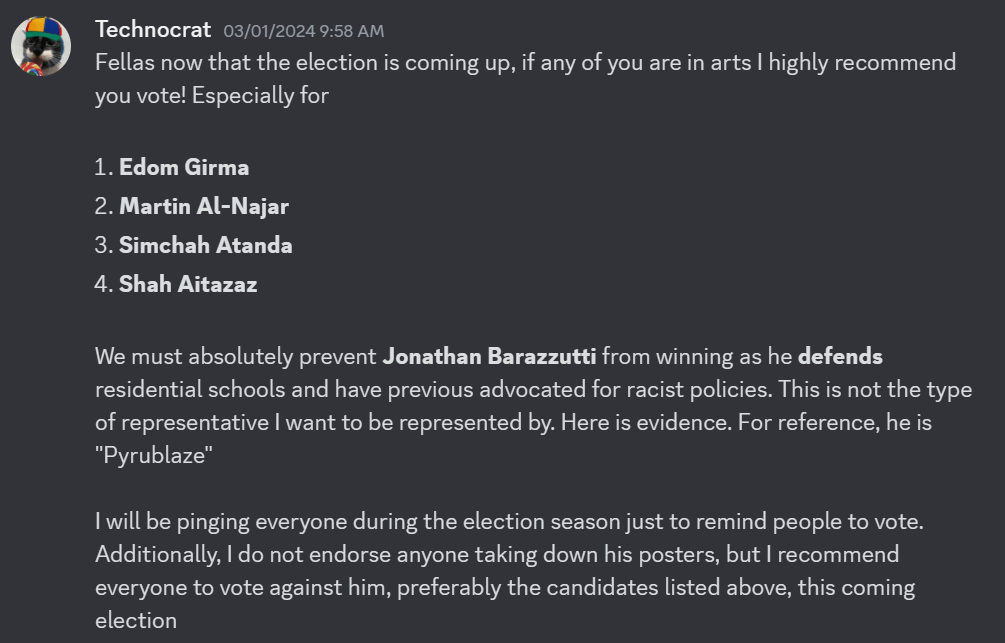
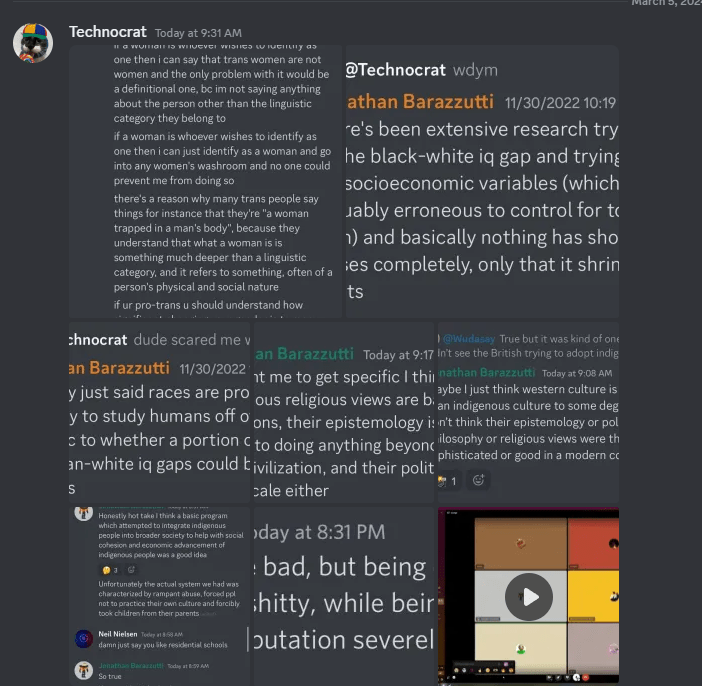
As far as I can tell, X and a few friends were owners of a substantial number of large class discord servers, each of which had anywhere from 80 to over 300 members. For each server, they would make a public announcement, often pinging everyone, and include some claim of me being racist alongside a barrage of screenshots collected over the course of a year and a half.
Over the next few days, I experienced a number of strange occurrences. Many of my campaign posters were continually getting ripped down, and I was increasingly finding out about the increased agitation of people over me online. There were individuals trying to go to administration to get me removed as a candidate for the SU election, people contacting other clubs I was involved with to try and get me removed as an executive, and several people who were talking about the idea of jumping me.
As my posters were getting ripped down, I was stuck with a challenge. I had a limited allowable spending budget for the election, which would be compensated once the campaign period was over. I was already at the spending limit, so I was forced to go over budget to replace campaign posters, being the only candidate in the election who had to do this. On the morning of the third day of the campaign period, I replaced posters which had been ripped down with new ones, but I had to stop partway through to do a scheduled classroom visit. 20 minutes later, I came back to the location where I had just put up posters, only to find that they were ripped down again by someone. I received a video from a contact which depicted the person in question ripping down the poster, and the direction they were heading in. I will refer to this person as Y. It should be noted that Y was a stranger to me, and someone who I had never interacted with in-person prior to this, which goes to show the strangeness of the situation.
I followed the trail implied by where my posters once were that were then ripped down, which led me to the university’s cafeteria area, where I spotted and confronted Y who was with their boyfriend. Y went on to pull up every “problematic” screenshot they got from a Discord server they were in, and I spent the next 20 minutes talking to Y and their boyfriend about my views. In the end, it seemed like we had reached an amicable agreement. Y agreed to not rip down my posters, and appeared to understand where I was coming from on things. I apologized to Y about what may have been an uncomfortable interaction, and they seemed very understanding about it. This, as it turns out, was an extremely incorrect assumption I had.
I decided to release a public statement on my instagram account, which mentioned the anecdote about my conversation with this person, and tried to affirm that I was not some evil person and that I was interested in unity. However, things continued to boil hotter and hotter as the election season continued. Even after I put up more posters following Y agreeing to not rip down my posters, several other individuals followed suit in ripping them down. I eventually became so burnt out from what was happening that I became inactive on my social media accounts and stopped putting posters back up. It was at this point that I received an email from The Gauntlet, telling me that they were writing a story about my “problematic” comments, and inviting me to do an interview regarding it:
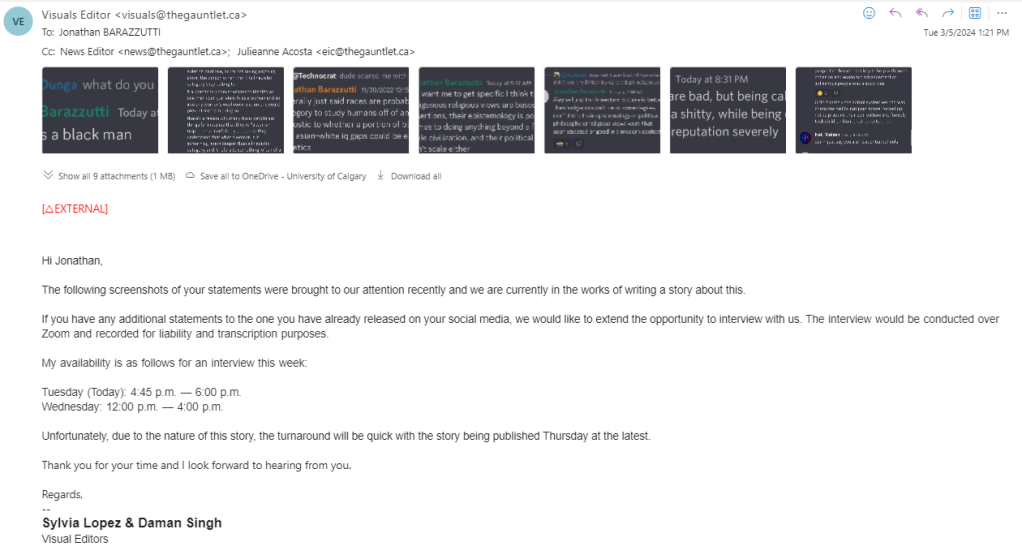
In the end, I (regrettably) decided to go through with the interview and try to engage in a good-faith, conciliatory way. In hindsight, this was a big mistake of mine. Looking back, I was significantly more defensive and apologetic than I should have been during the interview, and me taking the interview implicitly bought into the frame that I had done something heinous in the first place, when that was not the case.
The day after I did the interview, the election results were announced. The article by The Gauntlet was released a few hours before the end of the election. I attended the results announcement ceremony, during which I was confronted a couple of times by individuals who were hostile towards me. When the results were announced, what happened was exactly what I had expected up to that point: I lost.
The Aftermath
That evening, r/ucalgary blew up, and I was on the front page, with countless people commenting about how I was an evil person who deserved to be expelled, among other things. One person even went as far as to suggest I should be murdered for a joke I made, although this was eventually removed.
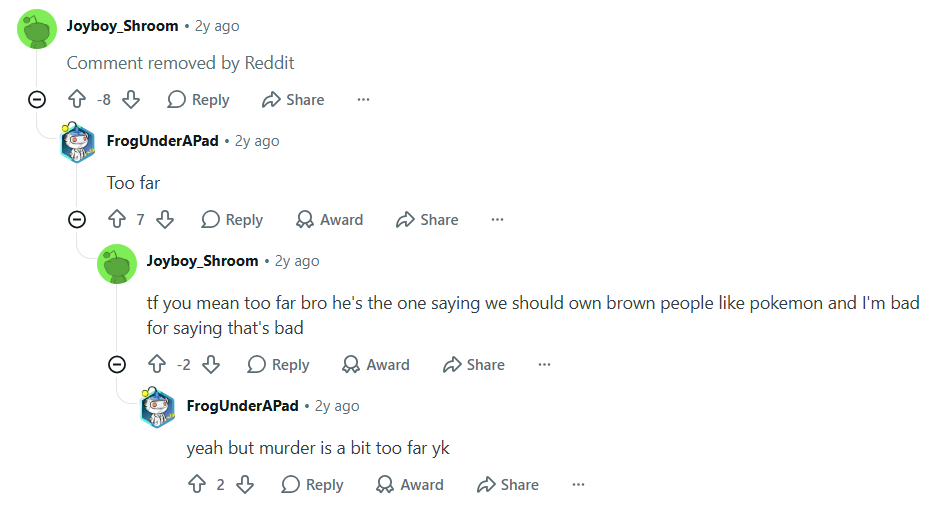
The YFD discord was raided by dozens of people who continually harassed me, I received harassing messages on instagram, and many other private things about me were leaked online for thousands to see. Multiple individuals I had considered close friends had backstabbed me, leaking logs of me ranting in private one-on-one messages or of me making a joke in a group call with friends for thousands to see. Some of this would end up being linked to in a second article in The Gauntlet released several weeks after the first, this time discussing my club, as one of the screenshots contained me saying that I was merely going to warn a person not to post an edgy Nazi meme instead of ban them.
One Reddit post which gained particular attention was written by Y, who saw my public statement which discussed our conversation. Y framed our interaction as an act of intimidation by me which caused them to fear for their safety. Among a number of strange claims made, Y said that they never violated university policy because there was no rule in the SU against students ripping down posters, despite the fact that the SU does not have any authority to deal with complaints about student non-academic misconduct.
Following everything, I spoke with the people who did not betray or abandon me and were still involved with YFD, and we agreed to shut it down. Thereafter, I deleted my discord, linkedin, and instagram account, and took a near complete break from social media. In the following week, I was kicked out of numerous clubs and organizations I was a part of. These include UCalgary Toastmasters, the Kula Ring (the undergraduate anthropology club), the Global Development Society (GDS), and the Faculty of Arts Students Association (FASA). The last two were particularly upsetting to me, as I was quite close with the GDS team prior to this, and FASA was my own faculty association which represents over 8,000 students, giving it a sense of gravity and legitimacy in my mind:
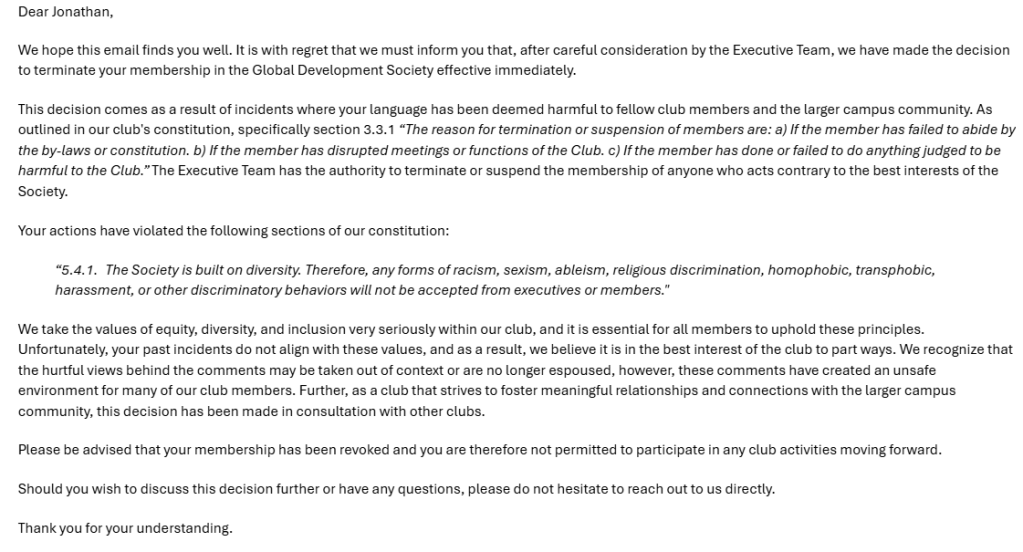
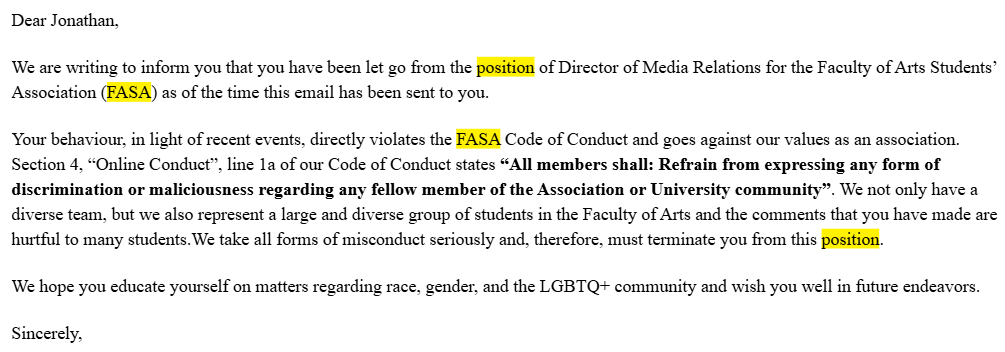
Several students also tried to get me kicked out of a mentorship position I was involved in, but I was able to keep that through conversations with the head of the program. In a sense, all of this was actually a good thing, as I was overextending myself and my grades risked slipping as a result.
Finally, numerous students had filed reports to try and get me expelled from the university. While I was eventually contacted by administration, I had never harassed anyone or violated university policy, and as such, I never actually got into any trouble. University administration was actually quite fair in the way they addressed the situation, leaving political biases aside, and was very helpful in future correspondence when I needed their assistance.
It is perhaps at this time that I should go into more detail about what exactly people were so upset about, and particularly how my views evolved and thus why I expressed myself the way I did at the time I got mobbed. I will discuss the three primary issues for which I had been mobbed: my position on indigenous relations, my position on race and intelligence, and my position on transgender issues.
To begin with indigenous relations, as I said before, the position I was expressing with regards to integration of indigenous people was not a pro-residential school position, but it was actually an anti-segregation position fundamentally. I recognized that there was a fundamental tradeoff between cultural preservation and equal outcomes, and was trying to figure out how to actually work with that tradeoff in a consistent way. In 2023, when I had originally made that position, I believed that equal outcomes were more important than cultural preservation. As such, it would be morally justifiable for the group with a culture less conducive to wealth creation to voluntarily integrate, economically and culturally, into the group with a culture more conducive to wealth creation. In the midst of arguing this, due to being harassed by a large number of individuals, I was rather heated in the way I articulated this position, which led me to use language in describing the position which I would not use in ordinary polite conversation. However, there was nothing fundamentally anti-indigenous about this view.
As time went on, I began to be more sympathetic to the idea that cultural preservation was valuable in itself, which led me to have doubts about my prior beliefs. In early 2024, I was still working out to what degree I held this position, and what its political implications would be. As such, I did not necessarily agree with what I had argued in 2023 on Discord, and was not ready to publicly take a stance on it during a mobbing. During the interview with The Gauntlet, the interviewers repeatedly pressed me to give a stance on these screenshots. After telling them several times that I didn’t necessarily believe the stance I held in 2023, but did not believe that said stance was particularly odious, I stated in blunt terms, “I’m agnostic to the question”. This has been repeatedly misinterpreted as me suggesting that I wasn’t sure if I supported the residential school system, which was never what the conversation was about, something which I even stated in a quote included in the final article. In reality, I have always been opposed to the residential school system.
I eventually worked out these uncertainties in my views on cultural preservation and its political implications, something which I have discussed in more detail here. To summarize, my present position would be largely similar to my position in 2023, but with a private-public distinction whereby freedom of association is allowed in the private realm. In other words, I believe that indigenous people should economically and governance-wise integrate into broader society, and that certain types of voluntary cultural integration may be valuable on this front, but that there should be the ability for indigenous people to voluntarily associate with one another to preserve aspects of their culture they seem valuable, either through ethnic-exclusive associations or even ethnic-exclusive neighborhoods at a small scale.
What about what I had said surrounding race and intelligence? As I have stated before, my position was that I had not seen evidence which would strongly sway me to the position that either population intelligence differences have a partly genetic origin, or that they do not. I maintained this position in early 2024 when I was mobbed, but interestingly enough, was never asked about it by the school newspaper. In mid-2024, I decided to do another deep dive into the research on the subject, and try to establish what the evidence most strongly pointed to, ultimately concluding that population differences in intelligence were most likely due to a mix of genetic and environmental factors. This position is in line with the majority expert view on the subject. I detail this, why I don’t think a part genetic hypothesis is unreasonable, and why I think the subject should be discussed in this article.
What about my position on transgender issues, specifically the “trans inclusion problem”? Ultimately, my position in 2023, 2024, and now is that it is possible to have a reasonable and coherent definition of what “man” and “woman” are without resorting to circularity that could still include transgender people in their desired respective categories. I believed that it was valuable to have such definitions which still included transgender people in their desired categories, due to a belief that gender transition was ultimately the best treatment for gender dysphoria. I have since become increasingly skeptical of this idea, particularly over the past six months, mainly due to a mix of seeing new evidence suggesting that transition may not alleviate psychological issues, as well as evolving views about medical ethics and the psychology of gender dysphoria which would take too long to get into here. Interpersonally, I would still use transgender people’s preferred pronouns out of respect, and my position is entirely based on what I believe is in the interests of people with gender dysphoria and society at large. However, I am no longer in full support of transitioning as an effective treatment for gender dysphoria.
At this point in my undergraduate career, I felt genuinely exhausted and downbeat. Almost overnight, dozens of people I was previously friends or acquaintances with wouldn’t even look in my direction, I had my trust in several close friends shattered, and I did not know if my future was virtually ruined and if I would get assaulted or worse. The day after the campaign period, two people who were close friends of mine actually reached out to invite me to do things off campus, so I took a break for the day. One of them, who I had told about the pledge I made after graduating high school that I would never lie about my beliefs again, asked me if the pledge was worth it. I didn’t know if it was. For weeks on end, I had a very difficult time getting out of bed, waking up every morning with a sense of profound dread about the future. It was a very low point in my life, and one which I have not psychologically fully recovered from to this day. I still have trust issues, I still have social anxiety, and I continue to feel isolated, despite the friends I’ve made and the accomplishments I’ve had since. At the time, the only thing I was motivated to do was focus on my classes, and so I ensured that I at least ended the semester with a strong grade point average.
Third and Fourth Year: Moving on
Things were by no means all bad, and the next couple of years would be a mix of ups and downs for me. I was lucky to get an internship for the summer, and despite my internship location getting doxxed on Twitter, my bosses did not find my views particularly odious. I began moving away from student groups, which led me to become more socially isolated. I took a lot of this time to do extensive research and writing projects, both publicly and privately. While I had done a fair bit of reading and writing before, I began to do so to a much larger degree, which has helped me evolve significantly in my thought in the two years since I was mobbed.
I was stuck with the challenge that my google SEO was terrible, as the first thing that people would see when they looked up my name was the article about me as well as half a dozen negative Reddit threads. While it’s hard to assess, I believe this has significantly harmed my employment prospects, as both of my main sources of employment since being mobbed had googled me before hiring me. I have since tried to address this to some moderate success, most notably through the starting of a blog. This blog would help me significantly improve my writing skills and helped me in landing my first position as a research assistant.
Throughout third and fourth year, I put up posters around the university promoting my blog multiple times, knowing they would generate significant attention. Each time I would, the posters would all be ripped down within 24 hours, and I would once again be the hot topic on Reddit. As a result, I had thousands of people visit my website, quickly skyrocketing it to the top of my google search results. Furthermore, the writing skills I gained in this process allowed me to excel in other places. In early 2025, I ended up winning a national essay contest for writing an article about intellectual diversity in universities, an essay which was heavily inspired by my personal experience getting mobbed. Thereafter, I wrote numerous articles for C2C Journal, eventually becoming the youngest official author for the publication, and have moved on to write for several other publications – most notably City Journal.
Nonetheless, despite my successes in new frontiers, there were still some bizarre experiences I ended up having in my last couple of years of my undergrad. While the drama had largely died down, there were some particularly strange occurrences that continued to happen. One was with a student I met when aforementioned former professor Frances Widdowson had actually come to the University of Calgary to do a public event in late 2024 outside one of the main campus buildings. I briefly went to the location to see what was being discussed, and while I was there, I noticed one student who appeared hostile to Widdowson was going around talking to numerous onlookers. This individual eventually came up to me, telling me that Widdowson was a residential school denier. I briefly talked with this person, disagreeing with the characterization, but over the course of the next few months we became friends.
Despite having substantial political differences, with this individual identifying as a communist and having more traditionally progressive views, we had civil discussions. Even after finding out about my past controversies and viewpoints, they did not express any hostility towards me. If anything, they seemed to gain respect for me over time. However, one day, after not interacting with this person for several weeks due to it being a school break, out of the blue I received a text from them:
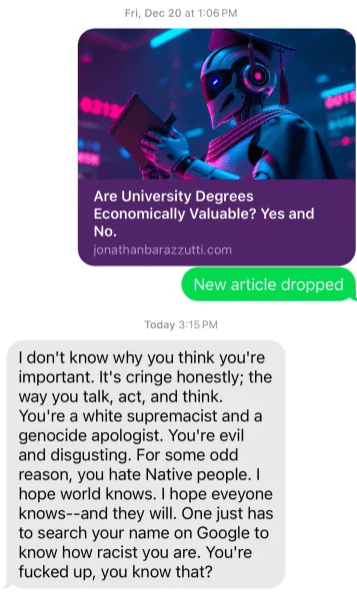
Over the next few months, this individual would repeatedly harass me in person, flipping me off and telling me to kill myself. At one point, while talking to a master’s student about a project we were working on for an advanced macroeconomics course on a walk through the university’s hallways, this individual followed us to confront my colleague about why he was talking to a “white supremacist”. Perhaps most ironically, during one of the times they had harassed me, they had told me to go back to Europe, despite both of us being of predominantly white, but mixed European and indigenous ancestry in genetics and appearance. I eventually went to university administration about this, after which they instituted a “no contact order” between the two of us. This luckily resolved the issue.
Another particularly bizarre instance was with a student who was previously an executive of YFD. This person was heavily involved with me, and helped me campaign for SU during my second attempt. They were aware of and did not care about my previous takes, and were nonetheless willing to associate with me during the campaign publicly. However, they began experiencing heavy pushback from students about their association, and eventually decided to distance themselves from me. When it came out that I lost the election, they immediately cut contact with me, and as the YFD Discord was being raided, this person decided to make a near-identical debate and discussion club to mine. Over the course of the next two years, this person repeatedly spread lies about me throughout the political community at my university, tore down posters for my blog or covered them with posters for their supposedly pro “free speech” club, and actively tried to get others to disassociate with me.
Two years after I ran for SU, this person attempted to run for SU president, during which they publicly put as their platform that they were simultaneously in support of freedom of speech on campus, but also wanted to push back against “growing violent authoritarianism on campus”. In promoting this latter point for their campaign, they began spreading numerous completely fabricated claims about me, most notably that I had created a chapter of the Dominion Society of Canada at the University of Calgary, an anti-immigration and pro-remigration group. When questioned on reddit about their past public association with me, they claimed that I had tried to get this club registered with the SU, and that they successfully fought against it, and claimed in other interactions that I and my members of this alleged club had begun harassing and assaulting students.
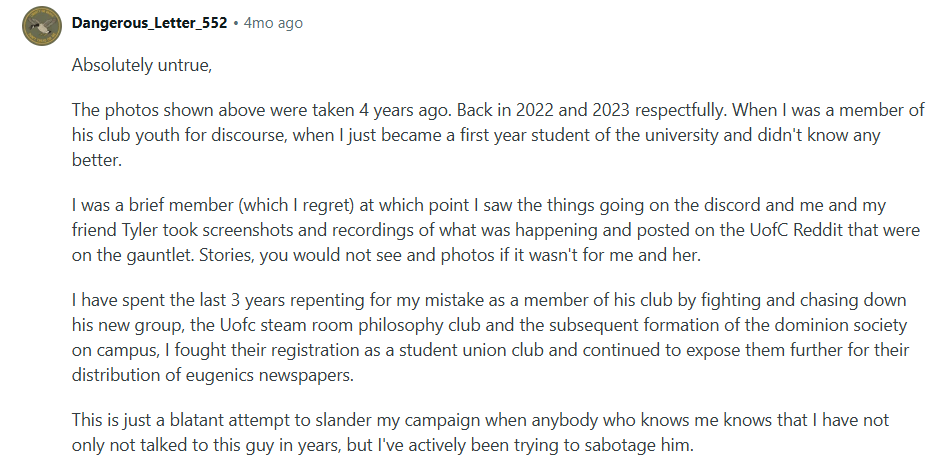
This is all despite the fact that I have consistently been pro-immigration, and that what I was mobbed for surrounding indigenous relations was fundamentally an anti-segregationist position. I have furthermore not made any student group since YFD, meaning that practically everything this individual had said was a complete fabrication. Luckily, this person lost the election by a landslide, but the whole situation was unfortunate because I was planning on having one final public YFD event after two years. The rumors which had begun spreading about me, even two years after I was mobbed, led me to make it a private event. It was nonetheless a wonderful event, but it goes to show the complete inability to have genuine open dialogue on campuses.
Nonetheless, in the end, I did end up getting what I wanted from the start in a sense. Throughout this, I was actively writing, reading, and researching behind the scenes, as well as extensively studying. This has allowed me to get very generous opportunities in recent months, which will mean that I will likely never have to worry about financial hardship in my life. However, while I will not get into the full details about the toll that all of this has taken on me, my undergraduate experience has felt uniquely difficult, isolating, suffocating, and demotivating. It has caused me immense psychological suffering which I never could have imagined entering university.
Part 2: Sociological Analysis
This is a very personal story for me. But it is important to examine this situation in a broader context. I am not the only person who has experienced this type of behavior, and treating me as someone unique in this situation is to suggest that what happened to me is not indicative of broader societal issues. It is first important to understand what exactly happened in technical terms, specifically through looking at the sociological study of mobbing.
What is Mobbing?
Mobbing refers to a type of group bullying behavior which can occur in a number of contexts, although is especially common in academia. Academic mobbing specifically is a non-violent, sophisticated ganging-up behavior adopted by academics to emotionally wear down a colleague through unjustified accusation, humiliation, general harassment, and emotional abuse. These are often directed at a target under a veil of lies, misrepresentations, and justifications so that they are hidden from others and difficult to prove. Campuses are common places for academic mobbing to occur, and this is done through shunning, gossip, ridicule, bureaucratic hassles, and the withholding of deserved awards. Bullies often use mobbing activities to hide their weaknesses and incompetence, and targets are often said to be innovative high achievers with good integrity and principles.
There are many conditions which can increase a person’s vulnerability to getting mobbed, and these can be inside or outside the control of the target. Some commonly discussed ones in the sociological literature include being exceptionally high-achieving in teaching or research, such that colleagues’ envy is aroused; publicly dissenting from politically incorrect ideas; or defending a pariah on campus or the larger cultural arena.
In general, academic mobbing tends to refer to behaviors done within a professional climate. However, the identical analogues can easily be found within an undergraduate student climate, where, through the social networks formed within classes, research, and student groups, the dynamics can easily occur. University of Waterloo sociologist Kenneth Westhues, who extensively studies mobbing, has a rough checklist of 16 items which are indicators of mobbing. He does not believe that all items are necessary to call a situation mobbing. My situation strongly corresponds with all 16, and demonstrates that my own experience can reasonably be classified as mobbing. I will go through these, grouping relevant items and using analogues from an undergraduate perspective when something related to employment is mentioned in the list.
1) By standard criteria of job performance, the target is at least average, probably above average.
Mobbing commonly occurs against individuals who are perceived to be a threat in some way. It is oftentimes not enough for someone to have dissenting opinions, so long as they are not acting upon them or actively doing anything. Someone who dissents from a group orthodoxy, and displays intelligence, ambition, and drive, is likely to inspire anxiety, envy, and resentment in others, which can be a strong catalyst for a mobbing to occur.
In my case, I was a very high-performing student academically, achieving a near-perfect GPA in a relatively difficult honours degree program and appearing on the Dean’s List in all four years of my undergraduate career. I founded a student organization in my first year, something which less than 1 percent of undergraduate students ever do, and grew the community to well over 130 people at several institutions across Canada over the course of a year and a half. I was also involved in an extensive number of extracurricular activities, where I mentored students, ran and managed events, and more. Even after getting mobbed, I continued to strive and achieve, not letting the event destroy me. By any measure of an undergraduate student’s “performance”, I was certainly at least above average.
2) Rumours and gossip circulate about the target’s misdeeds: “Did you hear what she did last week?”
This is often what happens prior to the climax of a mobbing. As individuals who wish to incite a mobbing incident have to assemble a collective mass of individuals who will support the action, there is a significant rise in private communications, rumors, and gossip about a target. When I ran for SU in the winter 2024 general election, this type of communication was extremely common, and can be seen throughout this part of my story. I recall that on the last day of the election season, hours before the election results were announced and the news article about me would drop, the frontrunner candidate in my race, who I had befriended, came up to me while I was studying in the library. They told me that throughout the election season, countless people had come up to them privately to tell them that I supported the residential school system, and how crazy it was that I was in the race.
3) The target is not invited to meetings or voted onto committees, is excluded or excludes self.
6) Unusual timing of the decision to punish, e. g., apart from the annual performance review.
8) Formal expressions of collective negative sentiment toward the target, e. g. a vote of censure, signatures on a petition, meeting to discuss what to do about the target.
As time went on in the SU election season, leaders of various student groups I was involved in were contacted regarding me. In the case of FASA and GDS, private meetings were held without my knowledge for the executives to decide what should be done about me, and ultimately led to my exclusion from numerous groups. These were done a month before there is usually executive turnover in such organizations, making the punishment decisions of these cases unusual. In the case of my position termination with FASA, I would later find out that a follow-up meeting involved executives discussing whether they should release a public statement about me to the campus community.
4) Collective focus on a critical incident that “shows what kind of man he really is.”
5) Shared conviction that the target needs some kind of formal punishment, “to be taught a lesson.”
11) The adding up of the target’s real or imagined venial sins to make a mortal sin that cries for action.
These points are perhaps the core aspect of what makes a mobbing a mobbing, and can easily be seen with the news article dropping at the end of the election season. This article was seen by many in the campus community as an indication that I was some evil person who ought to be ostracized and potentially expelled from the university. One can see the attitude that I need a kind of formal punishment in Reddit threads about me written soon after this critical incident. Many of these Reddit threads were a patchwork of screenshots and claims, many of which were false or misleading, but were nonetheless made to build an image of me as an evil person who must be dealt with in some way.
7) Emotion-laden, defamatory rhetoric about the target in oral and written communications.
12) The target is seen as personally abhorrent, with no redeeming qualities; stigmatizing, exclusionary labels are applied.
I will skip over these, as these have been demonstrated extensively in my retelling of the story.
10) Loss of diversity of argument, so that it becomes dangerous to “speak up for” or defend the target.
There were a number of individuals who tried to defend me, in online forums and elsewhere. However, those who did so non-anonymously themselves were put at personal risk. To this day, I have one or more friends who are privately in support of me, and yet are unwilling to tell mutual contacts about their private support due to fear of losing friendships as a result. Furthermore, some individuals had backstabbed me while I was getting mobbed, likely due to fear of getting mobbed themselves and wanting to distance themselves from me.
9) High value on secrecy, confidentiality, and collegial solidarity among the mobbers.
16) Mobbers’ fear of violence from target, target’s fear of violence from mobbers, or both.
Perpetrators of a mobbing are, in many cases, very fearful of the consequences of being found out that they themselves have perpetuated it. This is either because they believe that outside parties would view their actions as reprehensible, or because they fear retaliation from the individual they are targeting. As a result, a lot of the actions leading up to a mobbing are highly covert and secretive, and involve strong social solidarity between individuals. Prior to the climax of the mobbing, as there was a large amount of rumors spreading about myself, there was an emphasis amongst the mobbers that they not have their identities revealed, most notably stated here:

This general attitude can particularly be seen with discussions surrounding my conversation with Y, where Y had expressed a strong fear of even speaking about the situation due to believing I may retaliate in some way. Plenty of individuals anonymously offered support for Y in the comments, and many expressed a fear that I may go out to harass or potentially be violent towards this individual. Most bizarrely, a couple of weeks after the election, I ended up walking past Y in the hallway, who was with a group of friends. Seeing me, Y moved to the side of the hallway, with several of their friends positioning themselves in a way as if to physically block me from approaching Y. I had no intention of doing anything, and nothing in my body language would have signalled as such, making this a particularly strange moment of paranoia characteristic of mobbing.
13) Disregard of established procedures, as mobbers take matters into their own hands.
14) Resistance to independent, outside review of sanctions imposed on the target.
15) Outraged response to any appeals for outside help the target may make.
As I had said previously, in first year X tried to go to administration about me, and nothing happened. As a result, the mobbing that they did in second year when I ran for SU was an attempt to take matters into their own hands, as was the behavior of ripping down club or campaign posters by them, Y, and other individuals. There are many times on online forums where individuals expressed the sentiment that administration would not do anything about me, justifying the behavior many engaged in.
I don’t believe there would be an appropriate analogue to point 14 in the case of an undergraduate student getting mobbed, and I did not make any public appeals for outside help, making point 15 largely moot. I can imagine that if I had gone to news outlets off campus to tell my side of the story, as some online suggested I would, this would have been met with outrage. Interestingly enough, I was reached out to by a journalist from the Western Standard who offered me to write a story about my situation for them. I ultimately chose not to do this for personal reasons.
The purpose of discussing these 16 points is not to go down a laundry list, but to point out how quintessential a case of mobbing my situation was. To the extent that my situation could reasonably be able to achieve any of the points, my situation easily did. It is important to establish that this was in fact a case of mobbing, as it helps to understand what happened and why it happened in the way it did.
The Origins of Mobbing
Many people see various instances of mobbing throughout history, and view it as something which is an aberration of humanity, rather than something which is intrinsic to human nature. After all, how can groups engage in such irrational and extreme behavior?
In reality, while exceptional individual irrationality, such as a person presenting with schizophrenic traits, is abnormal, group-level irrationality and mobbing behavior is extremely normal and can actually be adaptive in many circumstances. In some cases, groups can be a surprisingly good judgment of descriptive claims. For example, Francis Galton famously conducted a study in 1907 which had nearly 800 participants try to guess the weight of an ox. Despite significant variation across the answers of the 800 participants, what is fascinating about this study is that the pooled answer was nearly identical to the actual weight of the ox. In this case, the group was a good judge because they were looking at a topic that did not deal with social pressures or dogmas, and each judgment was made independently of one another. The same cannot be said in cases where mobbing occurs.
In cases such as with mobbing, group polarization can often dominate. Group polarization is a phenomenon whereby as a group opinion about an issue is expressed, individuals within the group gradually become more extreme in their attitudes, leading the group itself to gradually radicalize in its position. This can create a positive feedback loop, whereby a group can gain unwarranted confidence in something in the absence of any reason to have such confidence. Isenberg (1986) conducted a review of the research on group polarization and found that the primary reason why it occurs is due to informational influence. Individuals see what the group as a whole thinks about a given issue, and take the group’s sum position as evidence that the position is stronger in evidence than it may actually be. As a result, the gradual radicalization of groups comes from individuals witnessing the majority opinion of others in the group as evidence that the position is actually correct. In my case, group polarization led to a greater sense of confidence over time that I had held odious views and deserved to be punished for them due to online dynamics acting as an informational cue about how I had committed some type of strong moral violation.
Today, people take for granted the fact that norms against behaviors which are extremely damaging to communities, such as crimes like assault and murder, are enforced through a legal apparatus. This was not always the case, and we did not primarily evolve in contexts in which this was the case. For the vast majority of human history, people lived in hunter-gather tribes, likely of no more than around 150 people, where relative cooperation was required among everyone in order for the community to sustain itself and keep everyone alive. In these contexts, norms, even those against extremely immoral acts such as murder, had to be enforced through social means. This can include types of ganging up behavior or banishment of people from social groups. As a result of this, people are naturally wired to engage in mobbing when they perceive a threat to occur, as it was necessary for group cohesion and survival in dire times.
However, while mobbing serves an invaluable role in communities without alternative mechanisms of norm enforcement, it has a high risk of establishing false positives and of policing behavior that is not actually detrimental to the community. As a result of this and other factors, legal mechanisms have replaced mobbing as the primary mode of enforcement for strong normative violations. Legal mechanisms allow for such violations, including assault, theft, and murder, to be dealt with in an impersonal and more rationalistic manner, rendering group mobbing unnecessary.
But even though mobbing may be unnecessary today, that does not mean that our brains have adapted to that reality. I hold that we are stuck with an underlying impulse for mobbing, without as much of a need actually to exercise it. This means that as time goes on, and legal infrastructure regulates an increasingly greater proportion of what mobbing would have reasonably enforced in its absence, mobbing behavior naturally extends to less and less important things. Furthermore, as material conditions improve in human societies, the relative number of issues which humans have shrinks to those primarily in the cultural realm, which concerns what people believe and what attitudes people have. As such, mobbing trends towards targeting those areas which, while not as important, can still constitute normative violations. These factors mean that today, in the vast majority of cases in which it occurs, mobbing is a vastly disproportionate response to whatever it is directed at, even when a legitimate normative violation has been committed.
With mobbing, oftentimes the impetus is started by one or a small handful of individuals, rather than by a large group. It is common for such individuals to display dark triad traits, including narcissism, psychopathy, and machiavellianism. I do believe that these played a role in my mobbing to some degree. However, it must be stressed that mobbing is a fundamentally neurotypical activity. Even if some individuals with particular psychologies can help spur on or exacerbate the consequences of a mobbing, mobbing is still fundamentally natural to humans.
Mobbing and Social Media
While most of the sociological work on mobbing dates back to before the advent of social media, which means that relatively little of the discussion of mobbing examines the ways in which it can interact with social media, social media was an integral aspect of how I got mobbed. It is crucial to understand the dynamics of social media in order to fully grasp how this mobbing operated.
Social media has brought a number of benefits to the world. It has allowed individuals the capacity to interact with others across the globe, and has provided new avenues for information to freely flow between people. If used carefully, a person using social media and the internet more broadly can become significantly more informed than anyone could have at any other point in history. Still, social media has been extremely damaging to public discourse, creating the worst incentives for behavior and the worst avenues for engagement.
The first thing which has to be understood about social media is that the medium is the message. The way in which information is transmitted through social media is qualitatively different from the way it is transmitted through other means. Social media relies primarily on messages utilizing conversational terminology, but in which the tone and broader context can be completely divorced. This oftentimes leads to a perception amongst individuals that individuals writing on social media are expressing more moral outrage than they actually are, which means that people have an inflated belief about hostility between people of differing beliefs. Such a belief can oftentimes lead to polarization, as individuals’ present attitudes are being shaped by exaggerated perceptions of what the other side is like. Furthermore, due to the permanence of the internet, things that are on the internet can forever be interpreted and reinterpreted for individuals entirely divorced from the time or social context in which certain things are uttered. All of this has an extremely deleterious effect on the ability for debates to be properly had online.
Many individuals who were involved in the mobbing indicated that their behavior was justified because I had posted on “public servers”, and asserted that it was especially odd that I posted under my real name. However, the particular places where I largely had the conversations which led me to get mobbed were the precise areas where these conversations were supposed to happen – namely, either on a server for a student group aimed at having proper dialogue, or a server for a class where my comments were relevant. In these environments, there should, at least ideally, be the ability to have conversations that may be more candid or experimental than they would elsewhere. It is in these areas where people’s ideas should be challenged, and people should have the freedom to entertain positions they are still figuring out. I never engaged in one of these conversations with the idea that I had all the answers. Rather, it was for teaching and learning in environments where those things should be welcomed. When these types of informal conversations are taken outside of a context they were supposed to be had, and plastered in a news article for thousands to see, this fundamentally takes away the underlying purpose of the conversations in the first place, and perverts any ability for people to be willing to have such conversations in the future. It is only when those types of spaces are created, where there is a private-public distinction in opinions expressed, and where there is the capacity to play around with opinions and even make jokes, that a genuine learning environment can be created – the very learning environment which universities purport to create.
The Consequences of Mobbing
Researchers of mobbing consistently find that ordinarily, targets of mobbing are scarred for life, often developing trauma-related posttraumatic stress disorder (PTSD). The targets’ position and influence in the organization they were a part of is destroyed, and targets tend to get ostracized and isolated, with colleagues shying away from the target out of fear of guilt by association. Targets often exhibit feelings of self-doubt, shame, worthlessness, and humiliation, becoming withdrawn and alienated from colleagues, friends, and sometimes families. One study estimated that 15 percent of suicides in Sweden were directly attributable to workplace mobbing.
Personally, I have experienced quite intense alienation from people, institutions, and society more broadly as a result of having been mobbed. There is not a day that goes by in which I do not think about it, even after two years. I have had many friendships destroyed, and many others permanently altered. I have greater difficulty talking to people and making new friends, and regularly experience anxiety when I interact with people in political spheres, even outside of my university, as a result of this. There are days when I am consumed by resentment, misanthropy, or envy, and I find it difficult to escape it. I have difficulty looking at screenshots of what I have said in first year or second year because of how traumatic the experience was.
As negative as the mobbing was to me personally, the worst consequences of mobbing are not its direct effect on the target, but its broader effects on the social structure. Mobbing creates a climate of intense self-censorship among students and others alike, which significantly reduces the ability for productive dialogue to occur. Extensive polling shows that a significant proportion of students and professors, particularly those who are right-leaning, the minority viewpoint on campuses, fear social or administrative consequences if they speak openly about what they believe in. When people see mobbing occur on campuses, that increases the number of individuals who wish to self-censor and fear not doing so.
Despite my situation being somewhat exceptional, in that it was the mobbing of an undergraduate student in an academic setting, academic mobbing for politically incorrect opinions is extremely common nonetheless, and this cannot be viewed as an isolated incident. While there are certainly unique circumstances within my mobbing which are particular to the individuals who perpetuated it, the individuals were not exceptional, and are largely representative of the types of people who will become the future businesspeople, lawyers, politicians, and changemakers of tomorrow. While the University of Calgary is not the top school in Canada, it is consistently ranked around 10th place among the top universities in the country. Individuals who were involved in the mobbing in one way or another have gone on to graduate programs at top universities in Canada, positions in government, as well as careers in journalism, among other areas. What happens at the University of Calgary can be said to have ripple effects on what is likely to happen in all aspects of Canadian society in future decades.
Over the past decade, there have been countless instances of professors and related academics being mobbed for their views, many of which I have expressed here. There are many individuals and organizations who have assembled extensive lists of professors or even students targeted for their speech, including this list from social psychologist Lee Jussim, as well as the Scholars Under Fire Database assembled by the Foundation for Individual Rights and Expression. As I have pointed out elsewhere, in Alberta alone, numerous professors have been targeted for their speech since 2010, including Frances Widdowson, Kathleen Lowrey and Paul Viminitz who were all fired from administrative or professorial positions, as well as Tom Flanagan at the University of Calgary who wrote a book about his experience getting mobbed. I am not alone in my experiences.
People generally don’t recognize either the importance of freedom of speech or the importance of having cultural protections for it. Freedom of speech is not so much for people to be able to have interesting conversations, although that can be a great aspect of it. Fundamentally, freedom of speech allows people to continually improve upon societal structures through enabling people to discuss social problems and their potential solutions. It is, at its core, an evolutionary process which can lead to significant innovation and societal progress when protected on both a legal and a cultural level. In order to exist, freedom of speech cannot merely be protected on a legal level. It also requires a culture which is willing to tolerate different viewpoints, ambiguity, playfulness, personal detachment, and more – what are often referred to as the norms of “modern discourse”. Mobbing is a direct violation of these cultural values, inhibiting their capacity to dominate social structures. In extreme cases, this can impoverish people over time, increase the risk of institutional failure, and limit societal progress.
Part 3: Thoughts on Politics and the Future of Academia
Who is Helped by Mobbing?
Thus far, I have largely avoided talking about mobbing from the perspective of those who perpetrate it. It is valuable to look at this perspective, particularly in my case, and specifically examine whether the mobbing which took place actually benefited everyone. A very common theme which came from those who wished to see me punished in various ways for my views was the idea that I had somehow harmed various groups of people, whether it be indigenous people or other racial minorities, or LGBT people. My words were not merely another perspective on how society ought to be run, but a direct attack on those groups, warranting some form of retributive action. But did my mobbing actually benefit people from these groups, on campus or off?
While mobbing has the function of enforcing social norms when other options are not available, it also serves a strong psychological purpose. As discussed previously, one of the fundamental signs of mobbing is that there is a sense of collegial solidarity amongst the perpetrators. And indeed, this solidarity can be beneficial for establishing social cohesion between individuals. Research on cancel culture – what can be regarded as a specific form of mobbing brought into the social media age – suggests that the practice can actually provide people with a sense of validation and empowerment. If someone in a group generally viewed as oppressed is told that someone is a threat to them, and then joins in to censure that individual, they can feel a great sense of community and belonging as a result.
I believe that there was a strong sense of catharsis from some of the individuals who had mobbed or harassed me, particularly those who came from the groups who I was alleged to have been hostile towards. Prior to deleting my old Instagram account, on the evening following the SU election results being announced, a couple of indigenous students tagged me in a story which asserted that a non-indigenous person had no right to talk about indigenous relations and that I needed to “do better”. I think that these two individuals were expressing a sincere emotion – a belief that my words had caused significant harm to their community on campus, and their public statements against me were an attempt to articulate that feeling.
There were many cases where individuals engaged in sadistic behavior towards me, which was likely motivated by nothing but to get a kick out of harassing someone. Many of the public and private comments made towards me and about this situation do not appear to have come from sincere concern that I had caused harm to people on campus, but from being given the moral high ground to mock and bully someone who is publicly seen as having no redeeming qualities. But as satisfying to my ego as it would be to characterize every action made towards me under these terms, I don’t think that it’s accurate to say so. Following being kicked out of GDS, a couple of the executives reached out to me on one or more occasions to check in on me. While they believed that my beliefs were harmful and warranted the actions they took, they expressed genuine concern for my well-being. Mobbing is a fundamentally cruel action, but it would be inaccurate to say that everyone who engages in it, in one way or another, is cruel or does not care intrinsically about the harm they believe the target caused.
Mobbing does provide many people with a sense of empowerment and catharsis. This is, however, short-lived. Unless it is combined with a broader cultural change which meaningfully improves the lives of the people the mobbing claimed to help, this empowerment is ultimately going to be a temporary and fleeting feeling. The past sixty years have witnessed a gradual cultural shift in favor of progressivism, the movement I was said to have threatened through my speech. But has progressivism actually delivered on progress for minorities, or for anyone else? To answer this question would go far beyond the scope of this article, but I want to make one important observation: none of my beliefs as expressed actually harmed the groups that I was claimed to have harmed.
The primary way in which people argued that my words caused harm was because they made people feel “unsafe” or offensive. Under this viewpoint, I had expressed viewpoints which constituted negative attitudes towards racial minorities and LGBT individuals, and would thus lead them to feel unsafe. Let’s examine these two individual strands. Firstly, did I express negative attitudes towards members of these groups? There’s no reason to believe that I did. In my personal life, I have met a number of racial minorities and LGBT individuals who agree with some or all of the views I expressed in the screenshots which got me mobbed, and have continued to be friends with me in part due to the politeness with which I have engaged with them. It would be strange to think that I secretly had such hatred for all of these groups, and yet have continued to maintain personal friendships with many members of such groups. It would also be strange to think that the individuals from minority backgrounds who agreed with my positions were agreeing with positions that were anti-them.
But even if I did express negative attitudes towards these groups, would this have been sufficient to warrant the idea that I made people on campus feel unsafe? This is highly dubious, especially given the fact that there is no evidence that allegedly negative attitudes against minority groups actually lead to psychological harm against said groups. For example, if it were the case that LGBT people were severely psychologically harmed by negative attitudes expressed towards them, then we would expect that LGBT people in countries with less tolerant attitudes towards their lifestyles would have higher rates of mental distress. But, contrary to the predictions of minority stress theory, if anything, the opposite is the case. What about racial minorities? In this case, there also is no clear link between allegedly negative attitudes and mental health. For example, despite the fact that black people continually report that they experience more racism on an interpersonal level than white people, black people actually have higher levels of self-esteem than white people on average. There is no evidence that anything I said about any of the issues I discussed had any demonstrable effect of making minority groups feel “unsafe” on campus.
On the contrary, what does make minority groups actually experience lower well-being is the inability to examine the possible limitations of the very ideologies which claim to help them. For example, what happens to social cohesion between racial groups when research into the causes of racial inequality outside of discrimination is continually suppressed, leading to a drastic rise in pessimism about race relations due to the continual perpetuation of a narrative which falsely attributes all inequalities to oppression? Does that benefit racial minorities? Does it benefit racial minorities when there is no ability to build a coherent ideology on whether to preserve cultural diversity or promote equal outcomes between groups, leading to a continual deadlock in any policy decision which may help with either?
I don’t claim to have all the answers to these and other social problems, but do the mobbers have them? Perhaps it is time to have open dialogue on why progressivism seems to have not addressed these issues – a dialogue which will require us to at least question the basic assumptions behind progressivism. But until that can happen, until there is the capacity for discourse within communities, inside and outside of academia, I don’t think I can say that progressivism is truly living up to the aim of progress. Maybe it’s time to move on? Is it possible to have a progressivism without progressivism?
Learning Forgiveness
Beyond all of the small indignities, acts of sadism, and humiliation I have faced, there is perhaps one thing which is the most significant act of cruelty throughout all of this, and fundamentally characterizes the mobbing at its core: it is the inability to extend forgiveness.
Progressivism in the modern era has oftentimes become continually concerned with grievances against particular groups of people. While in cases where these grievances were unresolved or ignored, this can be positive, a challenge continually pops up when it comes to the grievance politics of progressivism: when has a grievance been resolved? With every issue, as time has gone on, there have been ever more grievances invented, creating an infinite loop which leaves many progressives permanently unsatisfied with any progress made in any area they are concerned with. And this leaves the ideology as one unable to forgive its political enemies.
When I was in progressive circles, forgiveness as a political concept was never discussed, and due to the rise of the internet, which has polarized people and incentivized heated conflict, it rarely shows up elsewhere. It was only last summer when I began to encounter it in my readings in various places, most notably in the personal testimony of a person who was cancelled that strongly resonated with me. But even though I despised the inability of many progressives to tolerate political differences, or even to extend forgiveness for those they perceived as engaging in moral wrongs, I realized that I was ultimately hypocritical in this.
I myself had grown extremely resentful and envious over the treatment I was subjected to, and became a misanthropic person in the process. It got to the point where I felt genuine hatred for strangers I would see on campus and elsewhere, simply because I had seen the cruelty that other strangers had treated me with. And even though I regard the mobbing as having been an extreme overreaction to my views, I recognize that I myself made mistakes in my undergraduate career. There were times when I could have been more careful with how I worded certain things. There were times when I expressed hostility in a way I shouldn’t have. There were times when I wasn’t as patient with others as I could have been. Even though I believe the actions done to me were infinitely worse than what I did to anyone else, could I really expect others to extend forgiveness towards me when I couldn’t extend it towards them?
Furthermore, even though I like to think of myself as an independent thinker, it is entirely possible that, had things gone differently, I could have been the person trying to mob someone else. After all, I was a progressive in high school, and even though I eventually left that ideology behind, if a similar mobbing had taken place at my high school, it’s entirely possible that I could have acted in a milder but nonetheless similar way to how the people who mobbed me had treated me. How can I not consider forgiveness towards others for doing the same things which I could have done myself if things turned out differently for me? Maybe it was time to look inwards and take responsibility for how I myself could engage with others.
I am not presently at the stage where I can forgive the people who wronged me. However, I believe that this is a necessary and critical next step. It is only when we take responsibility for our actions, our thoughts, and our words, and extend grace to others who may not live up to these ideals, that we can actually create the harmony that progressives claim to want to achieve.
Taking Responsibility
I believe that in times and places where there is genuine injustice, there is also a profound opportunity for responsibility to be taken, and for genuine heroism to emerge. In the present climate in academia, which stifles discussion in favor of conformity and uniformity, there is genuine opportunity for creating paths which can help to restore the genuine ideals of discourse, open inquiry, and diversity of thought.
I have two primary aims in my life. The first is that I want to have a family – a wife and at least two children who will live on when my time on this earth is over. But the other aim I have is to create communities and institutions which are genuinely interested in searching for the truth. Institutions which go against the stifling, suffocating climate which characterizes so much of modern academia, and promote genuine curiosity, experimentation, and adventurism. I want to assist these efforts in any way possible, including helping to lead them if others are unable or unwilling to. The current academic institutions in place have, at the very least, struggled to succeed in what they outwardly claim to achieve. They struggle to promote genuine debate and dialogue, to effectively advance research, and to pursue the truth in a curious manner. I can’t help but find these institutions hollow and fake the more that I engage with them.
What happened to me was terrible, and should never happen to anyone. I don’t want my future children having to go through institutions or exist in a social climate 30 years from now which is as or more stifling than the one I have had to go through. If you are reading this, I want you to ask yourself if you would either. I want to connect with people who resonate with the themes I have discussed here, and are interested in talking about it or even building something bigger and greater than was before. If you are interested in this, please don’t be afraid to reach out to me.
I don’t believe that my story should inspire others to be pessimistic. It’s very difficult to change the problems with academia from within, but that doesn’t mean we can’t go outside of them and build alternatives. In the past four years, I have met countless individuals who have shared my dissatisfaction with how academic institutions currently are in one way or another. There is a demand for something new, and there are others in my generation who wish to be future scholars but see what’s wrong with the environments that are supposed to support them. With the rise of the internet and a recent societal pushback against many of the progressive orthodoxies I have laid out here, there is no better time than now to start looking to build community.
The one thing I wish I had throughout all of this was community, and I want to make sure that if anyone else ever goes through what I have, they will have what I wish I had. It is through building community that we can kickstart this genuine cultural transformation of the academy.

Leave a comment